Monday, November 27, 2023

Our Happy Place

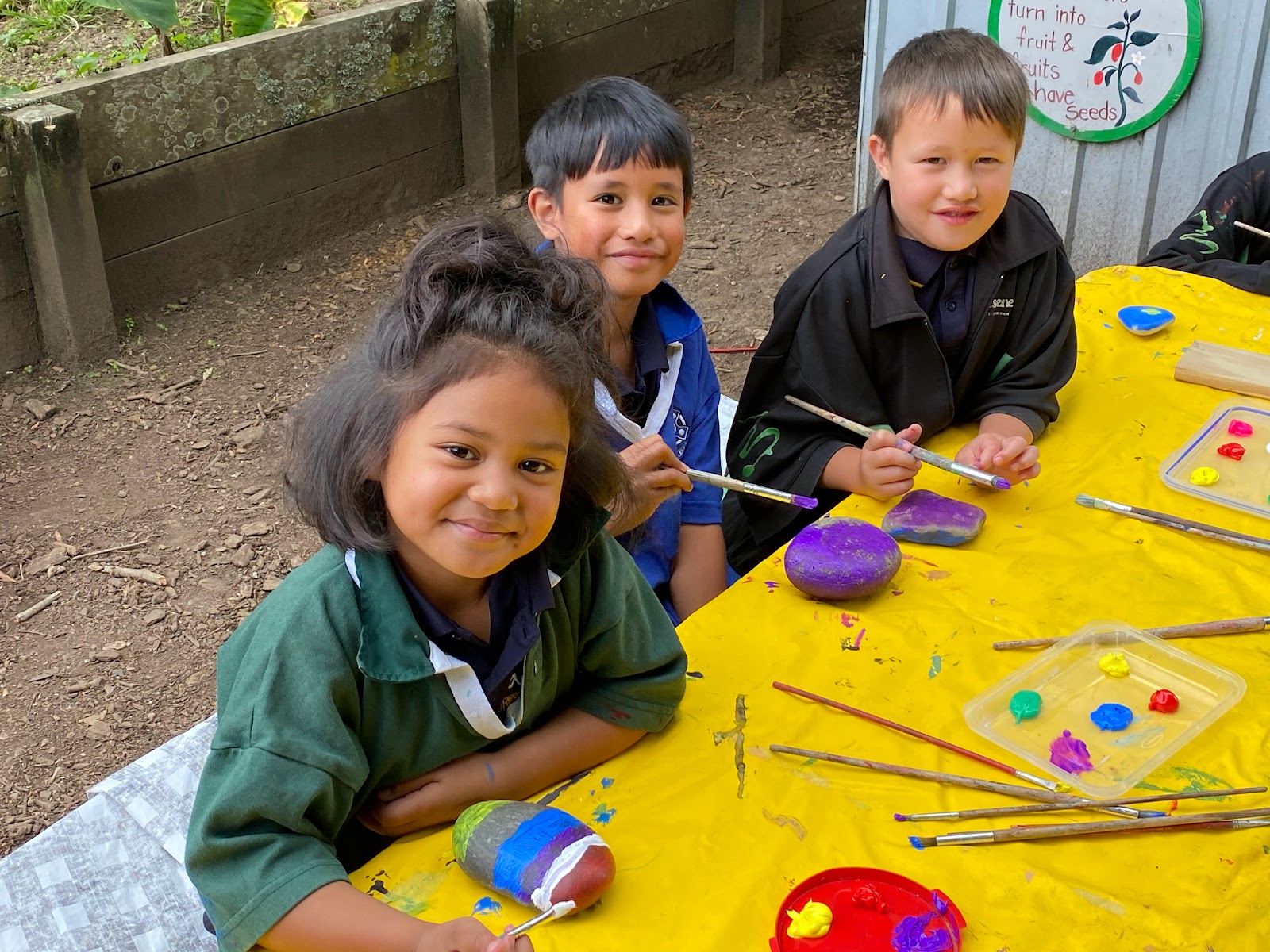
Here is the Green Team creating sunbathing rocks for the butterflies in our pollination garden. 
There is nothing more beautiful than our children learning in and about nature. 
Over the last few years, Tāmaki's school garden has become the children's happy place. They go there to explore, dig, plant, look for insects, write stories and play. It may look like an overgrown jungle at times, but the vegies are left to go to seed and then the seeds are collected and replanted. The children decide what to plant and are the ones who look after the plants. For some of our children, this is the only place they get to explore nature. 
Our children are so naturally curious about the natural world, how important is it that they have opportunities to explore those curiosities?


Friday, September 29, 2023

Was my hypothesis correct?

Was my hypothesis correct?

My hypothesis is that progress plateaus as students make sense of and consolidate new learning. It's almost as if they are close to cognitive overload. 

Mid-year running record data showed that my target students' progress had plateaued even though they in class were using and showing an understanding of new learning. Also, my class was excited about their learning, engaged, and working hard. I predicted that this plateau in running record data was due to the consolidation of skills and knowledge and that they were making sense of this information. 

And sure enough.... their new running record data a term later, shows that progress has definitely spiked with many now reading at or above the expected level. A massive accomplishment as they have now made 3 years of progress in just 2 years.  This is what we call accelerative progress. 

Of course, there are exceptions, the data highlights these exceptions and lets me analyze the possible factors influencing these student's achievement.

Two students have 20% attendance which means that retaining learning is challenging. 

Two students have high learning needs, It is equally exciting to see these students progress at their own rate and celebrate huge achievements as they happen. 

For a couple of students, progress isn't quite as fast as the majority. What is going on for these students? What can I do differently to help them with their learning... These students will receive extra support from me so that I can hone in on what works and what doesn't for them.


So what does my teaching of reading look like?
-A solid phonics session each day (Yolanda Soryl)
-Teaching decoding strategies; skipping over the word, rereading on and then rereading (Skippy Frog), breaking words up into chunks (Chunky Monkey), Re-reading the sentence when it doesn't make sense (Trying Lion). This comes from Beanie Babies, I use puppets to teach and model the strategies.
-Explicitly teaching comprehension strategies
-Reading, reading, and more reading in class (school is the only place most of my students experience books)
-Integration of writing and reading (teaching literacy)
-Fostering a love for reading and writing

I'm so proud of my students. They work so hard, love learning, and love reading. The magic of teaching and learning that was happening in Room 3 is now represented in qualitative data as well as the quantitative data that I see each day. For my students, many of whom have challenges outside of school that many adults can't even begin to imagine, school is their happy place. They love learning, strive for excellence, and connect their amazing experiences and knowledge with new learning. 

Having students a solid foundation to build future learning has been my aim. I can't wait to see where their learning takes them.


Wednesday, August 16, 2023

The Learner First PLD

My inquiry this year is into changing the way I teach maths to accelerate students' achievement and grow my own knowledge, skill, and love for maths.

My school's decision to engage in The Learner First PLD this year was perfect timing and just the inspiration I was looking for.

Over the last few years, my team has discussed our uncertainty about how to successfully cover the wide mathematics curriculum and how is it best taught. With so much to cover, it has always felt that coverage seemed almost impossible. 

Added to this was a lack of confidence in my own mathematical knowledge which stretches back to my own school experiences. 

TLF showed us how to use the NZ Maths unit planner to create coverage across the year and then add rapid routines and rich learning tasks to it to flesh it out. The introduction of Rapid Routines made me see how fun maths could be and put me in the shoes of the learner. 

What a transformation! 

I'm loving maths and love teaching it! Even more important is that my students are also now loving maths!

I'm not sure what it is that has brought about this shift... 

Is it that maths is now super fun? 

Is it that I can now stop stressing about covering the breadth of the curriculum?

Is it because I'm growing my own understanding along with my students?

I actually think it's all three. 

I'm seeing a massive acceleration, especially in student's number knowledge. I'm seeing excited faces and total engagement. What a win!

Friday, June 23, 2023

Tracking the progress of my students; When will I see progress spike?

I'm interested in what happens to progress as students acquire new skills and knowledge.

As mid-year reporting takes place I am fascinated by those students that attend school regularly, are busy acquiring so many new skills, and gaining new knowledge on a daily basis but are yet to show progress through assessments such as running records or JAM maths assessment.

My hypothesis is that progress plateaus as they make sense of and consolidate this new learning. It's almost as if they are close to cognitive overload.

The dose and density of learning that they experience in my class this year is intense however, seeing that they are loving it and they have an understanding of the learning progress I don't want the foot to be taken off the accelerator. 

I predict that once this new learning is consolidated then I will see a peak in progress by the end of the year. 

  • My students have a great understanding of the learning process; that learning is uncomfortable and that success comes through practice. They talk about this process on a daily basis and reflect on which part of the learning process they are currently at.
  • I also ensure that learning is kept fun with as much as possible coming from the student's own wonderings and areas of interest. There is obvious engagement happening.
  • It can be frustrating at times as a teacher, to see students taking onboard new learning during class and then not demonstrating it when it comes to an assessment task. 
  • Students that don't attend school regularly are showing little progress in class as well as through assessment tasks, compared to those students that are not yet transferring learning to assessment tasks but can demonstrate it with support during class.

I'm reflecting that they need scaffolding, multiple exposures of the skill being modeled, then multiple opportunities to practice with scaffolds and supports being reduced. This will then lead to being able to use the skill independently, and then finally being able to transfer it to new situations. 

Do many of our assessment tasks expect students to be extended abstract thinkers, transferring the skill to a new situation? Students would therefore have to have worked through the entire learning process for this to happen. When it does is when I think we will see that assessment data spike.


Tuesday, April 18, 2023

Cuisenaire Rods

For years a box of cuisenaire rods has been gathering dust among my maths resources. The students occasionally get them out to make patterns with and I have used them to learn about place value but I had never understood their true potential.


That was until I discovered this NZ Maths Unit!

Students assign a value to each rod based on the assumption that the white block's value is one. This was done through play and exploration.

The students then explored the relationship between the rods. Working together sharing their discoveries and then sharing back to the class was super powerful!

Students were then given a number e.g., 10, and asked to create a train to represent that value and then from there a mat of combinations that all hold that value.


This is an activity that can be used time and again with different numbers and adapted to suit different learning intentions. 

Now that I have unlocked the power of this resource I'm kicking myself that I never asked someone how to use this resource. Such a hands-on resource and perfect for creating open-ended learning activities!


Wednesday, December 14, 2022

Col Presentation- Reflection of my 2022 Inquiry into how to catch students up with foundation learning after Covid 19 and students missing their first year of schooling

Many of our Year 2 students started school this year at new entrant level. 
Data showed they didn’t know any words or letter sounds or have key concepts about print. The catalytic change was to build the foundations as quickly as we could in the first two terms (something that would usually take a year) so we could then have a basis to build the Year Two curriculum upon. 
A foundation skills programme on steroids! I felt that changing practice in my room alone was not enough and that the sharing of effective practice would lead to change across our school. So what did this look like? 
A balanced literacy programme; consisting of a strong Yolanda Soryl phonics based programme, alongside explicit teaching of decoding strategies like rereading and reading on, explicit teaching of Comprehension Strategies from the work of Alison Davis and hands on language experiences to build oral language and ignite a love of writing with the purpose of sharing their ideas. 
Knowing this was contradictory to the current trend of a structured literacy approach, I wanted to see if my hunch as having phonics be an important piece of a complex jigsaw puzzle of skills and knowledge needed to learn to read, not the whole approach, would catch our students up to be working within the expected level. 
After analysing my own teaching what I was doing well and what I wasn’t… I created steadfast daily routines, I used modeling books for the first time in years, this focused my teaching and gave the students a visual. 
We created a ½ hour dynamic phonics program each day which you could hear singing out of the classrooms as you walk through the hallways. 
We explicitly taught comprehension strategies to get our students thinking about the texts and used puppets to explicitly teach decoding strategies to help students when they got stuck on words. 
The easiest thing to change was our daily routines, having the PLC as a team, and setting aside time in our team huis to discuss our Literacy programme meant we could share the journey, supporting and bounce ideas of each other. 
The hardest thing was that we were all at different rates of change and coming at different entry points. The acceptance that change of teacher practice takes time is the hardest thing for me, who wants it to happen with urgency, to accept. 
My big takeaways from our programme is that it took just one term for our students to go from not knowing any sounds to knowing all initial letter sounds, being sound out CVC words and to manipulate the sounds within words and to be moving on to learning diagraphs. This was amazing and at the same time, the students also gained a memory of high frequency words.
They could also not only explain what visualising, inference and retelling were but could totally use these strategies to understand text. These comprehension skills they can build upon throughout their education.
They also love writing to share their learning gained through the hands on vocabulary activities. This has spread through our Junior school. It is a whole approach which I believe will give students a solid foundation to build future literacy learning upon. 
We as a team have worked super hard, it was relentless but we have so many of our students move from pre-level 1 to working within the expected level the hard work has paid off big time.

Saturday, September 3, 2022

Monitoring Effectiveness Of Our Interventions

My Inquiry Question: How can we effectively grow literacy practice across our school, developing a balanced literacy program that accelerates our students to where they need to be and builds a solid foundation for future literacy learning.

My Theory Of Action:

-To undergo PLC (Yolanda Soryl Phonics and Alison Davis Building Comprehension Strategies) as a team and share how we are transferring the PLC to our own classroom environments. Keeping the PLC alive within our Junior school environment.

-Creating a Team wide balanced literacy program that incorporates phonics, decoding strategies, comprehension strategies, oral language hands-on activities, and solid literacy routines. Ensuring quality literacy practice is happening across our team.

How am I collecting information about my changed practices/interventions? How am I collecting information about the changes that are happening across my team?

Monitoring Informally:

During guided reading sessions I am recording in modeling books how students feel about the lesson, and whether they understand or need more practice, as well as recording students' responses and a few little notes to myself. This helps me track the effects of my changed practice and monitor changes in progress in real-time.


I'm finding the use of modeling books is really focusing my teaching each session, students are able to see their responses and seem to be more aware of what it is exactly they are learning to do. The use of modeling books is a changed practice across our team. Although the teachers feel it is a little more work planning they feel the shift is a positive in terms of directing their teaching and having something the students can refer back to.
Having students working on whiteboards right in front of me during phonics allows me to monitor progress each session as well as address the things I can see happening and scaffold where needed.

Monitoring informally the transference of taught literacy skills and knowledge is monitored on a day-to-day basis during writing time. I am aware of whether transference is happening as I rove the room helping my students. I will usually write a little comment in their books that reflects the skills and knowledge I am seeing them use as well as a next step for them to work towards.


Monitoring Formally:

Using running record information:
What are they doing? What are they not yet doing?
Using this to inform my teaching, for example, students were not recognising word endings so this then became the next focus for my lessons.
Also, to find out if what we have already taught has been effective and if transference is happening.

What is happening across our team?

We are informally having more impromptu talks about what we are doing (changes to our teaching practice) and talking about what we are noticing our students doing/not yet doing, on a day-to-day basis.

Formally I have set aside a section of Team hui to
1) discuss how we are implementing the PLC we have received, and how this looks in our classes.
2) Share changes we are making to our practice that are working. This sharing of ideas and success is a great way to keep our programs alive, gain motivation from each other and celebrate the successes.
3) Discuss challenges we or our students are facing so we can share ideas and problem-solve together.

This is recorded in our Team Hui minutes so we can track our professional growth and refer back to it when needed.

Sunday, August 7, 2022

Collecting Data - Identifying reading behaviours

My inquiry focuses on supporting growing practice across our school through a collaborative inquiry approach with a teaching colleague.
After firstly identifying our target students, our next step was to identify our target students' areas of challenge and strengths. This was done by comparing running record data/ probe data, gathering student's voice, and anecdotal data of reading behaviors within the daily classroom. 
My colleague asked me to do my own assessment of her students to gain a different perspective and see if I identify the same challenges as she did. This was really beneficial as it means we both have a clear idea of where the students are at and where to take them next and was the basis of rich discussion about possible focuses on raising student achievement. It also confirmed what she had identified as challenges as both of us had noticed the same reading behaviors.

Reading behaviors noticed:


Monday, June 13, 2022

Manaiakalani Create Staff Meeting

Teaching Literacy Through Drama 

Big thanks to the wonderful group of educators from across our Manaiakalani schools that came to my drama workshop. The discussions around the power of teaching drama through literacy were thought-provoking and exciting. Love that drama strategies can be used across curriculum levels from new entrants right through high school to get students thinking critically and deeply about the elements of storytelling and the texts they are reading.

Using story fragments and the mapping strategy, together as teachers, gave us the opportunity to put ourselves in the shoes of our learners and become aware firsthand of the learning experiences that could possibly arise.


Thursday, May 5, 2022

How is my inquiry going to benfit everyone?

Every year I do an inquiry. It has an impact on my class, I innovate my teaching in response to a learning challenge identified within my own classroom.

This year though I am hearing the same challenge when I talk to other teachers not only in my school across levels but across our schools. What can we do to catch our students up after the massive amount of time they have had away from school? What can we do know that will make the biggest difference?

Surely there is no better time to pool our resources to share our practice so that we can take from each other those effective practices that are making a difference for our learners. 

We all have unique ways of making a difference in the learning of our students and can sometimes get stuck in the rut of what we already know. Instead of working in our silos, struggling with the same challenges why don't we break down those walls and take the best bits from each other and use and adapt when needed to meet the unique students' needs. 

I want my inquiry to be about shared effective practice across our school and how this can benefit all our students, not just my class. Lockdown has made evident the importance that a teacher has on the learning of a student. What if we multiply that power by combining teachers superpowers (the effective practices they have acquired through experience)?

Monday, April 4, 2022

What is my class landscape today? How is it different from 3 weeks ago?

What is my class landscape today (End of Term 1)? How is it different from 3 weeks ago?

Three weeks ago most of my students were at home. Only one student has been at school all term, unaffected by covid. The rest have had between 0 (some students not returning at all) and 4 weeks at school since the start of the year.  On average 6 students attend each day with the makeup of students different on any given day.

The upside of this situation was the ease of developing relationships with my students. The small class size meant each student got more teacher time. One-on-one time meant it was easy to assess their learning formatively and get to know them as individuals. This was so different from the usual start to the year where it takes a term to really get to know your students.

It was easy to do 'spare the moment', 'teachable moment activities', and to target individual needs as this I feel is sometimes where the best learning happens. For children with additional learning needs, they had my full attention which is much harder to give when you have a full class. 

By week 5, most students had been back to school for at least a couple of weeks, so most had learned our class routines. The downside was teaching routines up until this point was difficult with each day being like Ground Hog Day, having to reteach routines each time a new student arrived back at school.

Also, the inconsistency of attendance meant that students would start to learn things like the letter sounds and high-frequency words, then without having time at school they would forget what they had learned. It was like taking two steps forward and one step back all Term. This was challenging as my students had not attended school since before lockdown and prior to that had only had a couple of months at school, catching my students up on all the early literacy and maths knowledge and skills they had missed out on was something at the top of my mind. 

From Day 1 this Term, my team and I had the determination to put all our energy and effort into working with the students in front of us. Making the most of every moment that we had them with us. Covid has taught us how precious this time is and the impact we can have on student learning when we are face to face with our learners.

Today I have 12 out of 16 students back at school. The classroom is the noisy happy place that we have missed so much. The anxiety evident on students' faces as they returned to school has been replaced with happy excitement to be back at school learning with their peers. It is super strange to feel the excitement of the beginning of a school year right at the end of the first term, but that is exactly how it feels. Instead of feeling exhausted and ready for the holidays, we are feeling energized and excited about all the possible learning opportunities ahead of us. 

As each student returned to school I assessed their knowledge of letter sounds, the number of high-frequency words they knew and their number knowledge. With the exception of 2 students, they knew between 0 and 10 letter sounds, between 0-5 high-frequency words with the majority not recognising any and most students had knowledge of some of the numbers to 10. Except for 2 students, the rest of the students were at the pre-writing stage of making marks on the page. So it was safe to say most of my Year 2 students were working at a new entrant level. 

My goal from day one this term was to spend Term 1 jump-starting their learning by using dose and density to accelerate the acquisition of knowledge of letter sounds and the most common high frequency words. Most of my students now know the letter sounds ad with support can write at least the first sound of words during writing. They are still finding it difficult to remember high-frequency words. I'm really happy with this as learning all the alphabet sounds in a Term full of in attendance is I feel a great accomplishment. 

A major difference I have noticed this Term is our home school partnership with whānau. Our relationship is relaxed and communication free-flowing and easy with so many different ways to communicate. We used to have to wait to come into school a couple of times a year but now we can talk anytime. 

We are working together in terms of student learning. I feel this is a direct impact of lockdown whereby we had to find many different ways to connect with whānau and became so used to working together. We gained such a greater understanding and respect for our students within their whānau (not separate from them). For the first time in my teaching carrier, I feeI truly understand the power of strong home-school partnerships.

Yes, there is no doubt, my students, our at least a year behind where they would be expected to be at their age. But moving forward from here, what will make the biggest difference for our students as we catch them up to where they should be if covid hadn't happened? We are set with an amazing challenge of accelerating our student's learning, our students are hungry for it, excited to be back at school, and ready to learn.


Tuesday, November 2, 2021

A snail joins Room 2's online class

Today a snail joined our online class. I took the children (my computer) out to the vegetable garden to find a snail then brought him back inside. We looked carefully at him and used lots of fabulous words to describe him. While we had the snail right there we wrote stories about him. They had something right in front of them, something tangible that they could describe. 

This was the most effective online writing session so far. The best thing was that their stories contained multiple ideas. Up until now, I was finding it difficult to get more than a sentence from them. There was so much to say about the snail e.g., his shell, how he moved, the slime, the feelers...

We put him back outside but he didn't want to go and climbed back inside the door.

He wants to be in Room 2 too!

Here is the snail and our fabulous stories. 


Monday, October 18, 2021

Collaborative Maths Planning

In response to the reflections and feedback of one of my team members, we are collaboratively picking apart the maths curriculum to create a long-term plan that works for us, and that illustrates the learning outcomes across Level 1 and Level 2 of the NZ Curriculum. 

As a leader I see growing the capital of my team as important. However the 'how' to do this can at times seem difficult when everyone is at different stages of their teaching journeys and everone has diffrent levels of understanding of the curriculum. Noticing areas that need my attention as a leader is the first step. 

Stefan wrote an amazing, honest reflection about the hugeness of the maths curriculum and how difficult it was to know what and how to teach it, covering all aspects. At a PLC course he was shown diffrent schools' long-term plans and compared them to our long-term plan... honestly pointing out that what we were using was not effective, especially for the beginning teachers within our team. 

So.... we are taking our school LTP, taking the parts that we need to and as a team creating a plan that will work for us. 

Today we started with just one aspect, probability.

We looked at the Achievement Objectives from the Curriculm, the Elaborations, NZ maths plans, thought about our own understandings and broke down the specifics of teaching probability to our junior students. Doing this collaboratively over a google meet meant we were challenging each other, questioning each other and coming to a shared understanding. 

By the end of the session our brains hurt but the outcome was amazing. We all know what we will be teaching at each level, the shared language we will use and how to scafold learning to meet our students needs across the junior school. 

Yay for collaboration, and a fabulous team.... so much more powerful than if one person was to write the longterm plan and give it to the team to follow as we have done in the past!


Tuesday, September 21, 2021

Teaching During Lockdown; Ubiquitous Learning

During the lockdown, our students are learning in multiple ways. Some are learning independently, some with limited resources, some with help from whānau, and everyone at different times of the day.

This highlights the need for learning to be ubiquitous. 

Here are some ways I have adapted my teaching practice during this time to make sure children can access their learning anywhere at any time.

1. Making instructional videos. This is a fun way to create lessons that you would normally do in the classroom at home. Using materials takes the new abstract concepts easier to understand.


2. Using Jam Board and Screen Castify to make recordings of lessons, massive thanks to Matua Stefan for introducing us to this tool. Lessons like the one bellow allow you to make a visual representation as you explain concepts to your students.

Jam board has been such a great tool this lockdown. Having students talk to the Jamboard and explain their thinking as you record it is interactive and allows you make valuable formative assessment of where your students are at. You begin hearing things that would get missed within the busy classroom environment.

We have been using Jam board for online phonics lessons. We use the stickies to put the phonemes together in words or change the phoneses within a word to make new words.


3. Using Screen Castify to record shared reading books. This idea was gifted to me my colleage Whea Lee and I don't know why we hadn't thought of this last lockdown! It is always hard to get students to read texts at their level at home but how easy is it for them to follow along to a story read by the teacher. The teacher can use this opportunity to teach concepts about print and decoding strategies. They may not be reading the text independantly but hopefully they will be looking at the words and taking in some of those key concepts modeled.


4. Language Experience Videos gift students new vocabulary which is learnt in context, sentence structures and a range of new experiences. For these videos I have tried to slow my speech down and repeat language multiple times so that students hear it more than once. I have also explained some of the new vocabulary used.


These videos may not be the most well crafted but they hopefully do the trick and help my students connect to their learning. I hope this has inspired you to get creating and given you some new ideas for online learning during lockdown.

Sunday, September 5, 2021

Changes to my Practice During Lockdown


Suddenly we find ourselves in lockdown again.
This poses the question 'how can I continue to develop student's foundational skills during distance learning?'

What aspects of my teaching had I changed during class and how could I keep this practice going through lockdown?.

  • Building memory; As much of junior early learning has an aspect of rote learning and repetition, I had been focusing on memory games and that would hopefully transfer to remembering letter sounds, sight words, basic facts. I have integrated memory games into their reading program such as playing memory with sight words at school and then tried to create similar experiences at home using an Engage game 'Card Memory and connecting it to the text Hannah's Game.


  • Incorporating teaching of direction language into my daily program; the top slide shows another aspect of developing foundation skills, which is developing an understanding of directional/positional words. Experimenting with different ways to connect with students during lockdown I have found that videos of me doing activities is the most effective way of engaging students. They love seeing their teacher and seeing they can't read yet, seeing and hearing the 'how to's' allows them to easily access their learning tasks. This activity not only tells and shows directional language, they then have to use it to create a race themselves.

  • Development of gross motor skills, balance, and stability, hand-eye coordination; at school my students love doing exercise circuits after they have finished their writing. We also incorporate fine motor skill activities into our daily program as some students haven't the muscle strength and control needed to write with a pencil or cut with scissors. We talk about what skill the exercise is teaching them. I know this is best not to teach skills in isolation (vs within a context such as a game) but my students love it and it works for this particular group of students. Therefore to take this into their homes I again set them the challenge of creating their own exercise circuit 'boot camp' for them and their whānau. Instead of reinventing the wheel, I used resources that were already available as well as videos I made myself. I also gave students a yoga video to do as they love doing yoga at school.
Some resources I have incorporated onto my site are:


As well as some homemade videos by me... nothing fancy and slightly cringy but the students love them.


  • The last aspect is something I have carried over from my inquiry last year which is 'say, and do' language experiences. Using Dr Jannie Van Hees's technique of reusing and recycling vocabulary, say and do language experience activities related to a context outside of their daily worlds. This teaches them new vocabulary in context. 
How will I measure if this change of practice has had a positive effect on student outcomes? 

I will use whānau voice, student voice, and work samples to measure student outcomes. I will hopefully see student work samples and have feedback from my students on their return to school. Through talking to whānau, I have learned that students are using the site and videos and are engaged and motivated by them. They understand the learning tasks and are completing them. It will be interesting to see if the learning they are doing at home, transfers to learning in the classroom when back at school. 

Wednesday, August 25, 2021

Monitoring evidence, sharing, and interrogation

Share/Describe: I have been recording the changes to my practice on a target student tracking sheet. This is also a space to record the implications and reflections of my changed practice on student outcomes. This allows me to keep a running record of my changes to practice as they happen and then look back and reflect on how effective these changes have been. 

The example below is taken from the tracking sheet. This example is my record of incorporating physical activities, that help develop foundation skills, into my daily program. 

Changes to Practice:

Reflections/Implications

Term 2-3 2021

Incorporation of gross motor skill activities that target aspects of developmental skills such as balance, eye tracking, stability, hand-eye coordination, were incorporated into our in-class program with activities set up in class, in the hallway, and just outside the classroom.

This is done through circuits, games, and equipment is set up for students to do as a follow-up to writing. 

This also allows me to take smaller groups for writing while the other students were engaged and developing foundation skills that they may not otherwise have had the opportunity to do. Having a learning assistant working with one of the groups allowed more targeted teaching to take place with both groups.

Many of the games/activities were taken from PMP and Sport Auckland. Although it is suggested we incorporate skills into games, they enjoy both playing little games using the skill as well as just practicing the skill in an isolated fashion, eg balancing along a beam and skipping with a rope. I guess this comes down to setting personal goals for themselves.

The skill they are developing and how it transferred into different areas is talked about.

Week 4 Term 2

We have begun yoga once a week to help with body awareness, well-being and self-regulation. They LOVE it and work really hard to do it well.

Week 7 Term 2

I have attached the yoga video link to the class site so they can do it at home during lockdown.


Date: 7/9/21

My students enjoyed the activities and seemed to challenge themselves and each other in little competitions. 

The management of having circuits going while I took writing meant that both groups learning needs were being met in different ways.

They are transferring the skill such as balancing, into different areas of the curriculum. They talk about ‘balance’ and challenge themselves to balance in different ways throughout the day.

I’m seeing noticeable changes in student's core strength and ability to sit on the mat and in a chair to write. Fine motor skills of holding a pencil and writing have improved. They love to skip and will skip at any given opportunity. Also having the equipment such as balance boards set up in the room means they just jump on and start balancing at all times of the day in a really natural unplanned way.


Literature Link : 

PMP

Sport New Zealand


PLC sessions with James Mcintyre; Sport Auckland


Explain: I have made many tweaks along the way and have used the tracking sheet to record these changes. With foundation skills being such a huge area to develop at one time I have taken the little and often approach. Putting the foundation skills I'm focusing on into my daily routine running alongside more traditional Year One curriculum areas such as writing and guided reading and maths as well as integrating them through games in these areas that involve movement. I am not taking away from the normal practice I hopefully strengthen it by having foundation skills being taught and developed alongside these programs. I keep having to ensure all students are challenged by the activities because there is such a range of developmental levels within the juniours and students master the skills quite quickly. Also, I have added choice by having inquiry stations set up within the same time so students can explore concepts and oral language introduced through inquiry. These times have been where I have seen the most engagement, oral language take place and independent learning happen. It takes it from being a circuit set up, where students move through like little robots, to an activity you can choose alongside other provocations that help them explore in their own way skills they need to develop. 

As the skills I'm focusing on developing are vast, ranging from teaching oral language, concepts, and phonological awareness to gross and fine motor skills and self-regulation skills it is a juggling act fitting them into your daily program. Recognising your student's needs at that time helps with this as it focuses your attention on those areas that might make the most impact. 


Our Happy Place

Here is the Green Team creating sunbathing rocks for the butterflies in our pollination garden.  There is nothing more beautiful than our ch...