Showing posts with label CReflect. Show all posts

Saturday, September 3, 2022

Monitoring Effectiveness Of Our Interventions

My Inquiry Question: How can we effectively grow literacy practice across our school, developing a balanced literacy program that accelerates our students to where they need to be and builds a solid foundation for future literacy learning.

My Theory Of Action:

-To undergo PLC (Yolanda Soryl Phonics and Alison Davis Building Comprehension Strategies) as a team and share how we are transferring the PLC to our own classroom environments. Keeping the PLC alive within our Junior school environment.

-Creating a Team wide balanced literacy program that incorporates phonics, decoding strategies, comprehension strategies, oral language hands-on activities, and solid literacy routines. Ensuring quality literacy practice is happening across our team.

How am I collecting information about my changed practices/interventions? How am I collecting information about the changes that are happening across my team?

Monitoring Informally:

During guided reading sessions I am recording in modeling books how students feel about the lesson, and whether they understand or need more practice, as well as recording students' responses and a few little notes to myself. This helps me track the effects of my changed practice and monitor changes in progress in real-time.


I'm finding the use of modeling books is really focusing my teaching each session, students are able to see their responses and seem to be more aware of what it is exactly they are learning to do. The use of modeling books is a changed practice across our team. Although the teachers feel it is a little more work planning they feel the shift is a positive in terms of directing their teaching and having something the students can refer back to.
Having students working on whiteboards right in front of me during phonics allows me to monitor progress each session as well as address the things I can see happening and scaffold where needed.

Monitoring informally the transference of taught literacy skills and knowledge is monitored on a day-to-day basis during writing time. I am aware of whether transference is happening as I rove the room helping my students. I will usually write a little comment in their books that reflects the skills and knowledge I am seeing them use as well as a next step for them to work towards.


Monitoring Formally:

Using running record information:
What are they doing? What are they not yet doing?
Using this to inform my teaching, for example, students were not recognising word endings so this then became the next focus for my lessons.
Also, to find out if what we have already taught has been effective and if transference is happening.

What is happening across our team?

We are informally having more impromptu talks about what we are doing (changes to our teaching practice) and talking about what we are noticing our students doing/not yet doing, on a day-to-day basis.

Formally I have set aside a section of Team hui to
1) discuss how we are implementing the PLC we have received, and how this looks in our classes.
2) Share changes we are making to our practice that are working. This sharing of ideas and success is a great way to keep our programs alive, gain motivation from each other and celebrate the successes.
3) Discuss challenges we or our students are facing so we can share ideas and problem-solve together.

This is recorded in our Team Hui minutes so we can track our professional growth and refer back to it when needed.

Wednesday, August 25, 2021

Monitoring evidence, sharing, and interrogation

Share/Describe: I have been recording the changes to my practice on a target student tracking sheet. This is also a space to record the implications and reflections of my changed practice on student outcomes. This allows me to keep a running record of my changes to practice as they happen and then look back and reflect on how effective these changes have been. 

The example below is taken from the tracking sheet. This example is my record of incorporating physical activities, that help develop foundation skills, into my daily program. 

Changes to Practice:

Reflections/Implications

Term 2-3 2021

Incorporation of gross motor skill activities that target aspects of developmental skills such as balance, eye tracking, stability, hand-eye coordination, were incorporated into our in-class program with activities set up in class, in the hallway, and just outside the classroom.

This is done through circuits, games, and equipment is set up for students to do as a follow-up to writing. 

This also allows me to take smaller groups for writing while the other students were engaged and developing foundation skills that they may not otherwise have had the opportunity to do. Having a learning assistant working with one of the groups allowed more targeted teaching to take place with both groups.

Many of the games/activities were taken from PMP and Sport Auckland. Although it is suggested we incorporate skills into games, they enjoy both playing little games using the skill as well as just practicing the skill in an isolated fashion, eg balancing along a beam and skipping with a rope. I guess this comes down to setting personal goals for themselves.

The skill they are developing and how it transferred into different areas is talked about.

Week 4 Term 2

We have begun yoga once a week to help with body awareness, well-being and self-regulation. They LOVE it and work really hard to do it well.

Week 7 Term 2

I have attached the yoga video link to the class site so they can do it at home during lockdown.


Date: 7/9/21

My students enjoyed the activities and seemed to challenge themselves and each other in little competitions. 

The management of having circuits going while I took writing meant that both groups learning needs were being met in different ways.

They are transferring the skill such as balancing, into different areas of the curriculum. They talk about ‘balance’ and challenge themselves to balance in different ways throughout the day.

I’m seeing noticeable changes in student's core strength and ability to sit on the mat and in a chair to write. Fine motor skills of holding a pencil and writing have improved. They love to skip and will skip at any given opportunity. Also having the equipment such as balance boards set up in the room means they just jump on and start balancing at all times of the day in a really natural unplanned way.


Literature Link : 

PMP

Sport New Zealand


PLC sessions with James Mcintyre; Sport Auckland


Explain: I have made many tweaks along the way and have used the tracking sheet to record these changes. With foundation skills being such a huge area to develop at one time I have taken the little and often approach. Putting the foundation skills I'm focusing on into my daily routine running alongside more traditional Year One curriculum areas such as writing and guided reading and maths as well as integrating them through games in these areas that involve movement. I am not taking away from the normal practice I hopefully strengthen it by having foundation skills being taught and developed alongside these programs. I keep having to ensure all students are challenged by the activities because there is such a range of developmental levels within the juniours and students master the skills quite quickly. Also, I have added choice by having inquiry stations set up within the same time so students can explore concepts and oral language introduced through inquiry. These times have been where I have seen the most engagement, oral language take place and independent learning happen. It takes it from being a circuit set up, where students move through like little robots, to an activity you can choose alongside other provocations that help them explore in their own way skills they need to develop. 

As the skills I'm focusing on developing are vast, ranging from teaching oral language, concepts, and phonological awareness to gross and fine motor skills and self-regulation skills it is a juggling act fitting them into your daily program. Recognising your student's needs at that time helps with this as it focuses your attention on those areas that might make the most impact. 


Sunday, August 22, 2021

Learnings from Te Whāriki

He puraora i ruia mai Rangiåtea e kore e ngaro.

A Seed sown in Rangiātea will never be lost.

Te Whāriki states that teachers, educators and kaiako work in partnership with whānau to realise the hopes and high expectations whānau and iwi have for each child. The vision underpinning Te Whāriki is that children are learners are nurtured like a precious seed, instilling in them an understanding of their own importance and their belonging within society. They are "Competent and confident learners and communicators, healthy in mind, body and spirit, secure in their sense of belonging and in the knowledge that they make a valued contribution to society." 

On the day lockdown began, I had started to write this blog post looking at te Whariki as a guiding document and how this interlinks with our focus on developing a foundation program for Juniors. As I began to write I reflected on the partnership between school and whānau and had a sinking feeling that it seems to often be an aspect of our teaching that can be surface level. By this I mean students are dropped at school by whānau and go home to them at the end of the day with a wave and quick hello, how are you, but really is there true partnership happening? Is it an equal power relationship where parents feel comfortable talking openly with their child's teacher? Does the teacher understand and value the hopes and aspirations each whānau has for their child? Do we take the time and make the effort to find out? Do whānau feel comfortable within our classrooms and know and have input into the learning that happens. Do we understand and value all the learning that happens at home?

Lockdowns have taught me that true relationships between whānau and teachers are powerful and can be a massive impact on student outcomes. 

I have made a mindset shift to purposefully form true relationships with whānau. This is not on a superficial level, this is valuing the contribution whānau brings to the learning of our tamariki. It's forming relationships that are nonjudgemental no matter what the situation is at home. It's listening to them, looking at things from their point of view, and working with them to help students learn in ways that are important and right for that family. 

For at least one of my students I strongly believe that the partnership his mum and I have, has changed his world in a significant way. The walls between school and home have come down, his whānau are helping him with his learning in their own beautiful way and he comes to school proud of the learning he is doing at home. He is able to make connections between this learning and the learning happening at school and build upon these connections. Learning is ubiquitous. The progress he is making is incredible. He has progressed from working at a developmental level of a 3 1/2 year-old, to being able to write a sentence, know all alphabet sounds, and read a sentence. I could have been judgemental when I learned about the challenges he and his whānau face, I can imagine many would. I could say that I have no control over what happens at home. But I do have control over my own beliefs, judgments, and the impact these have on others. By having understanding and true relationships based on trust and respect, there is no judgment. There is a partnership with a little learner (seed) at the center who is being nurtured by those around him and given optimal opportunities to grow. 

Lockdown for our Junior Team as with other deciles one schools allows us to see inside the homes of our whānau. We make phone calls, we do check-ins, google meets. Our parents become the teachers and we are one of their resources. They let us see into their worlds. we need to do this with uttermost respect and aroha. The relationships that are formed through this time are a true asset and like the story above brings down the walls between home and school. I can't help but feel this is what that sinking feeling that I had reading Te Whāriki referred to. These are the relationships that underpin Te Whāriki and that we need to treasure in our practice as teachers. 

In my early years of teaching I had relationships with families that I felt a connection towards but can I say I had strong relationships with those families that were more difficult to connect with... no I can't say I did...and how much of that came down to my own judgments and comfortableness. Probably more than I was willing to admit. 

I think it is important I don't let these learnings as an educator slip away. I look forward to continuing to weave the Te Whāriki aspect of Partnership through our junior school beliefs and practice and our school curriculum.


Sunday, July 25, 2021

Using Old Telephones To Develop Oral Language

When our office received new telephones our wonderful Principal put the old ones aside for Room 2 knowing what a fantastic tool they would be for developing oral language.

T set up the experience, I did virtually nothing. All I did was put the 4 telephones on a table in pairs so that students could sit next to each other with a telephone between them and allow time for the children to explore using them when they saw them. 

What happened? 

Wow, what an amazing oral language activity;

Two of my students both with speech difficulties sat side by side. One of these students has amazing vocabulary and concept understanding, she oozes confidence and doesn't let her speech stop her from getting her message across. The other student has a lower level of vocabulary and will often sit quietly and let others share. 

Conversation 1

B- "I at the pool"

G- "What you doing there? (then corrects herself) What are you doing there? Are you swimming or something?"

B- Thinking... I dit (I did)

G- " At the school holidays I went to Granny's"

B- Copies sentence structure "At the school holidays I went to Inflatable World.

G- "I went to Gravity and it was a lot of fun and I can't even breathe when I'm jumping too fast."

B- "What?"

G- "I can't even breathe when I'm jumping"

B- "I can not breathe."

G- "Bye-bye"


Conversation 2

L-"Hi, who is this?

B- says their name

L-Stutters then says "Where do you live?"

B-" Somewhere. In the clean house."

L-Thinks... "What way does (pauses) it go to?" (meaning 'how do you get there?')


What oral language are students developing from this activity? 

Students modeling oral language for each other:

  • Asking and answering questions
  • Rephrasing  "I can't even breath when I'm jumping"
  • Being cognitive of what they are saying, thinking about what they are saying and what they want to say to get their message across. L- Thinks... "What way does (pauses) it go to?" (meaning 'how do you get there?') It may not be correct but they are making conceted attempts
  • Copying sentence structures G- " At the school holidays, I went to Granny's" B- Copies sentence structure "At the school holidays I went to Inflatable World.
  • Extending their speech through listening to each other.

This is a great example of using props and role-play to facilitate oral language development. The cognitive process involved was evident and it gave an opportunity for multiple aspects of oral language to be developed in a hands-on real-life, social context.

What other props can I use for students to develop their oral language through role-playing such as this?

Saturday, June 5, 2021

The Development Of Foundation Skills; Balance

Hypothesis:  If we focus on developing students' foundation skills then this will transfer to progress in reading, writing, and maths longitudinally. 

Foundation skills are the foundations we build our 'traditional' learning upon. If students miss out on acquiring these skills in the early years then how can we be expecting them to build on something that just isn't there. As time is of the essence my hypothesis is that if we can build these skills alongside key early literacy practice then the skills will transfer from one domain across to the other at an accelerated rate. Students are not missing out on those early literacy skills that don't get taught further up the school, yet they are at the same time developing the skills needed to consolidate that learning. 

These skills are 


Exploring this hypothesis  I have taken balance, a foundation skill that influences the ability to adjust movements, muscle strength, core stability, sensory awareness, and movement reactions, and created opportunities throughout each day for the students to develop this skill. 

First I did a quick assessment of students' balance standing on one leg, hopping, walking along a low beam, and their ability to sit still on the mat (core stability and strength). Some students found these activities challenging. These students also are pre-writing stage, making marks on the page yet to form letters.

Then I made a trip to Kmart to buy balance boards.  I placed these in my classroom. As soon as the students saw them they were on them. They seemed to gravitate to them throughout the day as a way to calm and center them as if they were seeking the stimulation. This reminded me of the readings I had done about play schemas. 

I also incorporated movement games and activities throughout the day that developed balance. Each time we did an activity we talked about how balance strengthens our core and helps us to do certain activities. The outcome of this is that students can now identify activities that help them to balance and choose these activities independently "Look miss I'm balancing." They seem to enjoy the challenge of seeing if they can balance in different ways.

The exciting thing is that I'm seeing it transfer into formal learning. These students can sit for longer periods on a chair or on the mat. They seem to hold a pencil easier and are beginning to form letters correctly. The latter part may not be connected to balance but there is a noticeable difference in a short period of time.


Tuesday, December 15, 2020

CoL 2020: Evaluation Of The Intervention/ My Changes To Practice

Changes to teaching practice over the last two years have seen significant shifts in my student's oral language acquisition, extremely pleasing progress in reading and surprisingly huge shifts in my student writing data (surprising because I had intended to gain shifts in reading). All within the craziness of teaching and learning with the challenges of Covid-19.

What did I do differently?

  • Two-week high-interest topics exposing the students to as much rich vocabulary within contexts that were outside of their day to day worlds or connected to wonderings about everyday phenomena that they didn't have the vocabulary to explain. Before this, we would teach whole school topics for the whole term. By making this change I saw the urgency in exposing students to as many different contexts as possible but still at a deep level. This also meant giving students hands-on engaging activities that they could connect new vocabulary to, and prior experiences and knowledge that they can build onto as they move through their schooling. Example Of Two Week Unit
  • Shifted my two-week high-interest topics to a digital platform. For this, I had to be mindful that my young students were mainly learning independently without parent help. I videoed me taking through hands-on activities, using resources they may have at home and explaining, using, reusing and recycling rich vocabulary. Video evidence showed students doing the activities and using the vocabulary at home which was exciting. I kept this going via our class site after lockdown for those students who still had not returned to school and to follow the Manaiakalani Pedagogy of learning being ubiquitous Learning At Home
  • Valued the use of students first language within the classroom. This allowed students to make connections to English through their heritage language. I created opportunities for students to learn in their first languages and share their language with others. I utilised the opportunity for families to help their children with their learning at home during lockdown by shifting to more culturally responsive teaching practices. I became aware that I needed to be cognitive about this as it was easy to slip into old habits, especially when faced with a different way of teaching and learning e.g. totally online teaching. A Shift To More Culturally Responsive Teaching

The Effects Of My Changed Practice/Intervention

Reading

Whole-Class Reading Graph Tracking Students From 0-120 Weeks At School


Target Student Reading Graphs For 0-120 weeks at school

Student 1

Student 2


Student 3


Student 4

Whole-Class Reading OTJ Data 


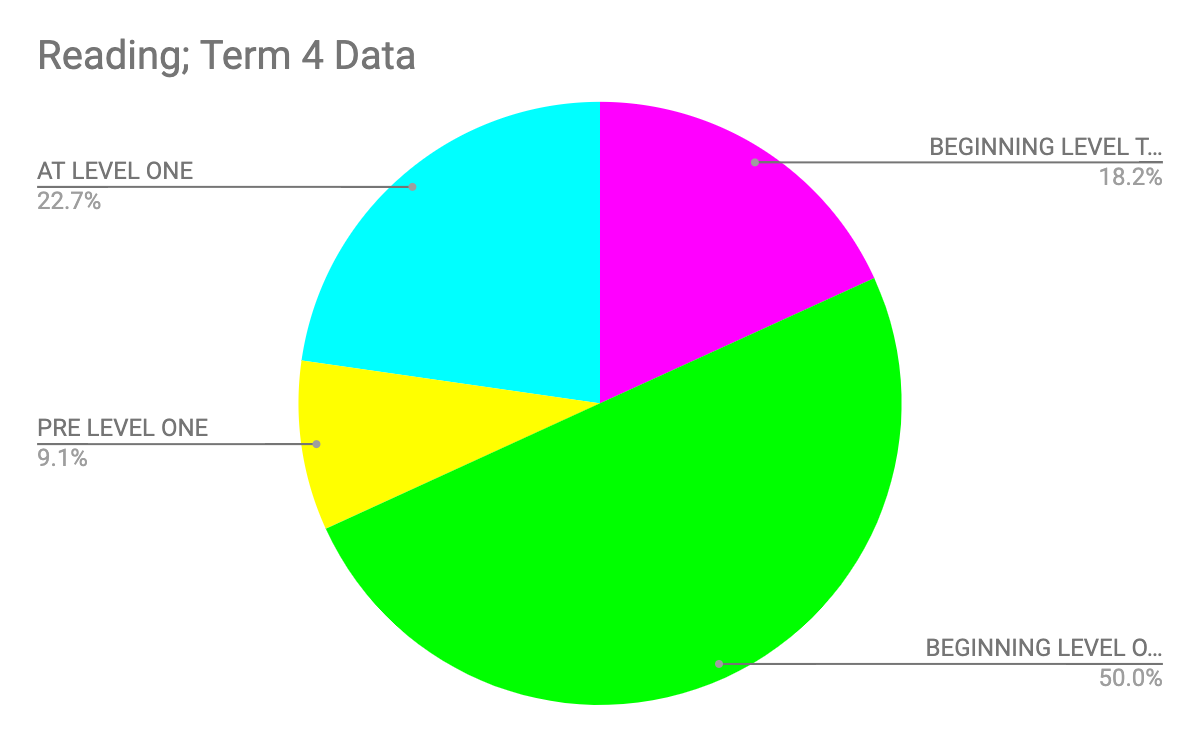
This data shows that those students that returned to school after lockdown made accelerated progress of expected progress. This surprised me as usually after time off school e.g. summer holidays their reading level drops back. Also, many of my students' families were going through difficult situations due to lockdown/covid and from my own experience, difficult situations at home can influence students learning at school. 
The Pie Graph shows that many of my students are still working below the expected level for their age but some of these students are just one colour wheel level of reaching the expected level. I, therefore, believe that with the continuation of this intervention they would quickly reach where they should be. 

Writing

EAsstle Results Term and Term 4 For Target Students

Results show where my target students sit against National Norm from Week 3 Term 4 EAsttle writing sample. Since this sample was taken my students started to make even greater progress, as shown on the below pie graphs.

Whole-Class Writing OTJ Data 


Their writing shows that they are now able to sequence their ideas. They have the vocabulary to express themselves and their sentence structures are becoming much more complete. Having engaging experiences to write about not only motivated them but they also had so much to share and the language to use that the writing became so much easier. They went from students who would say one or two-word utterances who found it difficult to say a sentence let alone write it....to students producing writing like the piece above. 

Next Step:
My next step is to support my team to implement the intervention across the Junior school. I know implementing change across a team can be challenging, especially gaining buy-in however I hope this data shows that a rich oral language acquisition programme makes a difference to student learning and has the capability to accelerate student progress. 

Saturday, November 28, 2020

What happens when light hits an object?

What happens when light hits an object?

My CoL inquiry has been looking into developing student's oral language using two week, high interest topics hands-on learning tasks. 

This weeks topic has been light.

This has been my lesson sequence:

1) Look at our shadows outside in the play ground. Why do we have a shadow? Does anything else have a shadow. Introduce the words; shadow, opaque, the concept of light coming from a source (the sun) and an object blocking the light's path. 

2) Read in dual language book 'Shadow Sleeps' . Students listen to audio in their first language and take the book home to share with their family.


3. Introduce the concept of reflection e.g. like light bouncing off. Discuss that some objects reflect light. Sit in a circle and students role play light traveling in waves to another person and bouncing off of them. Students take turns to walk across the circle and pretend to bounce off someone. 

4. Give students a torch, mirror, paper plate and magnifying glass.students make a prediction what the light will do when it hits the object. Gift students the words penetrate (meaning the light goes through it), reflect (meaning the light bounces off it), or block (if the object is opaque). Students ten experiment to see what happens. 


5. Explore making rainbows. students say and do as they 

Say And Do Activity

Students say and do as they

  • Fill up a glass of water.
  • Put the glass of water at the edge of a table.
  • Balance it slightly over the edge of the table.
  • Put a piece of paper on the floor next to the table.
  • Shine the light through the water to make a rainbow.

The students then write what they have learnt about light.


Evidence of student learning:

The hand-on activities allowed students to use the new vocabulary in context. Me modelling simple and correct sentence structures using new vocabulary resulted in students themselves copying these structures. For some this was challenging and took effort, however all achieved this. The amount of talking during these sessions was awesome. There were questions being asked and problem solving (critical thinking) happening everywhere you looked.
The student's writing showed the increased fluency due to having 'lots to say' and engagement. Sequencing of ideas and use of new vocabulary. I have also noticed a marked improvement of sentence structures. 


Tuesday, November 3, 2020

Learning About The Water Cycle

When asked the question where does rain come from the only answer my students could give me was that it came from God or "I don't know", with a shrug of their shoulders.

Their amazement during our first activity of simply painting water pictures on the concrete and watching the water evaporate showed that this was a new experience and something they hadn't thought of. Because previous to the experiment we had talked about the sun heating up water and evaporating it, this language transferred easily. 

"Look the water is evaporating...it's going up to the clouds!"

Such simple everyday phenomena brought such amazement and when given the words my students could put these words to an experience that although they had witnessed many times before had never contemplated or understood. 

The second activity we learned about condensation by making a water cycle in a bag. Here the students could see the condensation on the side of the bag as the water heated up and then turned to water vapour and then cooled. We made lots of connections to steam around their house and why the mirror was wet after a shower. We gifted and gifted and gifted more vocabulary!


The third activity was creating a cloud in a jar to show what happens when clouds become heavy with water droplets. This was incredibly exciting and a great way for the students to see what happens. Explaining what words mean is a norm within our classroom therefore if the students didn't know what a word I used meant they would ask. I would take my time to explain the word sometimes using pictures, diagrams as I talked or role play.

The last activity was creating a water filter to understand what happens to water as it runs off the land into our streams and lakes. They were then able to make connections to our drinking water and water conservation that we had touched on earlier on in the year. 

The discussions and writing that resulted from this topic were incredible. All students understood the basics of the water cycle and concepts of evaporation, condensation and precipitation. They loved using the terms and extremely easily explained how their water filters worked.

To collect comparative data I compared an EASTTle writing sample recounting doing one of the experiments to writing about something they did in the weekend. Nearly all the students in my class wrote better quality recounts about doing the experiments than their weekend experiences (bearing in mind it was Halloween). In particular, the organisation of their writing and ideas noticeably improved. I feel this is because they had a lot to say and their ideas flowed naturally in a clear sequence. 

Earlier in the year many of my students struggled to put anything onto paper so this change is huge.

I also believe that these concepts and experiences are now able to be built on throughout their schooling. When my students come across content related to water they will be able to draw on these experiences and have the foundational knowledge that can be built upon. We may not see the benefits of building oral language now but I believe that results will be seen further in their schooling.


Evidence of Student Achievement


In the water cycle, the sun heats the water to do evaporation. It goes up to the cloud to be condensation and if the cloud gets too much water it's going to rain. That's called precipitation. 

By Elijah


The Unit Plan

Monday, October 19, 2020

Learning Vocabulary Through Creating A Beebot World

Below is an example of the two-week topic that I used with my class. 

As I worked through the unit my focus was on vocabulary and giving multiple opportunities for students to use and reuse through hands-on experiences, and opportunities to talk with peers using that vocabulary. This is now always at the forefront of my mind as I teach. At the beginning of my inquiry, I found this was more of an effort....with practice it has now become automatic and something that has come through on observations of my practice. 

The result is that the students are talking more using the new vocab through multiple opportunities and the vocabulary and concepts attached to that vocabulary is coming through in their writing.


Thursday, August 27, 2020

Monitoring, Recording and Tweaking During Lockdown

What did I plan to do?

My aim going into lockdown was to create culturally responsive, online learning opportunities utilising student's heritage languages. It was also to continue with the intensive oral language programme through high-interest topics outside of their daily worlds, hands-on experiences and exposing students to new vocabulary and using, and reusing this vocabulary.

What did I actually do?

  • Sent home dual language books, a writing book and a pen.
  • Created culturally responsive online learning activities to go with the dual language books.


  • Created videos that took students outside of their daily lockdown worlds, using topics that were high interest. I knew my students loved learning about nature and our native creatures. I used these videos to introduce new vocabulary in context. I hoped they would then use these words in their writing.

  •  
  • Used hands-on activities related to the text we were reading, I was aware from the last lockdown of the limited resources that our students have available at home. So I tried to think of activities that they would have resources for. I was also aware that these activities really worked for some of our students last time.

  • Used google hangouts as an opportunity to get the students writing.
  • Used a facebook post to encourage whānau to help their child to write a story and read a book each day.

How did I monitor my implementation and student progress?


It was harder to monitor the implementation of changes of practice and to know whether it has had an impact on learning. for the main two factors. 
  1. A third of my students came to hangouts and it was difficult to know if the other students were engaging with the learning activities at home. I will have a clearer picture of the home learning that has taken place once we are back to school next week.
  2. I was difficult to see student's work as most have yet to master uploading learning to google drive.
However, here is a description of what I have noticed from my observations.

Different activities and learning resources appeal and are used by different students. What works for one family doesn't necessarily work for another. Having a range of learning opportunities, resources and multimodel options allows all students to access their learning in different ways. Having a writing book, pen and ready to read reading books including dual language books, in a learning pack meant that all families were able to connect to learning at home. The uptake of this we will find out next week when back at school. More of the students that connected were reading and writing each day using these resources than the first lockdown. Was this because I clearly set the expectation this time using my facebook message, and were having writing sessions each day online?

The writing response and quality of writing from the videos I made were fantastic. All students were able to write facts. They were writing with fluency and were able to clearly articulate what they wanted to write and had lots to say. The vocabulary they used was directly from the videos. This showed uptake of the new language.


Having whānau helping was really effective and a great way to build that home/school partnership and whānau involvement in their learning. Some whānau that were not connecting during the last lockdown were joining in every day this time. I want to put out a survey for parents to find out whānau voice and how they experienced online learning. 

Student voice told me the hands-on activities were a hit with some students. It will be interesting to see learning outcomes next week when back at school, as I currently don't have work samples of this.

Below is a sample of an on-line writing session. It shows Cohen sounding out his words and the increased amount of writing these students have been doing, and the engagement of the students.


It was hard to monitor the effect of culturally responsive activities and resources. Return to school next week will hopefully give me a clearer picture of the effectiveness of this change of practice.

Next Steps:

  • Send out a survey for whanau to record their experiences with on-line learning and to gain whānau voice regarding the effectiveness of my change of practice and how it impacted student learning at home.
  • Gather and assess work samples from students returning to school to gain a better understanding of the impact of the implementation of changes of practice during the lockdown.

Friday, July 17, 2020

How PELP Changed My Practice

What Is Language?


Language is the words or symbols we use to communicate meaning, it is arbitrary, and it can convey information about things that are not present in the current place or time. (Northbrook, 2020)

However, it is far more than a tool to communicate meaning and ideas. It is deeper than that. It is fundamental to what it means to be human. Not only does language learning shape meaning and capability, but it is an integral part of culture and identity. Language and culture are intertwined. With the loss of language, we see the loss of culture and cultural identity. (MOE, 2016)

How taking part in PELP has changed my understanding of literacy acquisition.


PELP has made me aware that building on a child's heritage language or languages helps strengthen the acquisition of English as a second language and I have seen first hand the power of drawing on a child's cultural capital to support literacy learning.

I have known that learning is about making connections, connecting new knowledge and skills to our prior experiences and beliefs, however until recently I hadn't thought about the part language plays in this...if language shapes meaning and capability, then surely making space in the classroom for children to use their heritage language to make connections and build understandings makes sense.  

For me, PELP helped me understand the 'why', it showed me the 'how', it supported me in changing my practice to be a better teacher and it opened up possibilities. It quite frankly has totally changed a part of how I teach and my pedagogical beliefs. 

I came to Tamaki Primary from a high decile, predominately Pakeha school. Myself having grown up in England for half my life and then teaching in a school that was reflective of my own culture I knew very little of the Pasifika cultures represented within my new school. Although I jumped at the chance to take part in PELP I was completely outside of my comfort zone attending the first workshop. Fear of what you don't know is always scary, which is crazy as we all know that that is usually an indicator opportunity for learning. I can remember clear as day the thought "How can I teach using dual language books when I don't know the language myself?" 

From what I know now - I don't need to, I have a have half a class of Tongan speakers who are more than willing to be the experts... I just need to value their language and culture and create space to explore literacy in their language and allow them the opportunities to make connections between Tongan and English. 

So what has PELP taught me?


  • Opening up opportunities for the students to be the experts, to bring all their knowledge, their culture and language to the table and to be able to connect this to their new learnings.
  • Value bilingual and multilingualism and foster it within our classroom. Know that it is easier to acquire a second language when one is strong in their first language.
  • Value the cultural capital that students bring to school. Use this to help build literacy acquisition.
  • Try speaking in Pasifika languages. Students love it when you attempt to speak their language. This in itself is valuing their identity.
  • To use the dual language books as you would any other reader, and utilize the audios online. Think of follow up activities that may help students connect their culture and language with English.
  • Create opportunities to use Pasifika languages and cultures across the curriculum e.g. Count in Samoan, use the Cook Island Maori colours in art.
  • The importance of listening to families and understanding the students within their family and home context. 

What am seeing as a result of my change of practice?


  • The students going from not associating the languages they speak at home with the school context and not speaking them within the classroom, to students now using their heritage language across the curriculum.
  • Students competing to use their language when we are doing counting or playing games e.g. let's count in Tongan!...no Samoan!,
  • Students giving the meaning of Samoan words or telling me what an English word or phrase means in Tongan. They are verbally translating constantly.
  • They naturally speak to each other in their own languages in the social context of the classroom.
  • They are fiercely proud of their culture. 
  • Massive confidence and overall happiness of students and a sense of belonging.
  • They use the illustrations in the books to discuss the story and make connections to their own experiences. 
  • Families are realising the importance of building using heratage language and that it can help their children to acquire English as a second language. 
  • A spark of interest in students that don't speak in their heritage language at home. They have also become aware that they do not know their heritage language from seeing their peers speaking in their language at school.

What are my next steps?


  • Increase my knowledge of Pasifika cultures, as this has highlighted how little I know.
  • Increase opportunities for families to come in to share their culture with the class. 
  • Create more ways to be culturally responsive in my teaching practice.

PELP is such an effective programme. I encourage all teachers to run with this opportunity. I have been amazed how easy it actually is to make these changes to your practice and even more amazed at the incredible effects it has on the students. 

Push past the fear of not being an expert and make those first few steps... and just see what happens!


Here is a link to my first few reading lessons using the dual language books 


Sunday, May 31, 2020

Reflection Of Engagement With Learning During Lockdown


I have written a quick summary of how a selection of my students connected and engaged with online learning during the lockdown and reflected of the differences between families. Learning was provided via our class site and students were able to connect with me during two hangouts each day. The class site provided tasks across the curriculum, including high-interest hands-on inquiry tasks. Instructions and models were given using explain everything videos, teacher videos, audio and written instructions.

Student's 21 and 22 couldn't connect to hangouts but completed most of the tasks on the class site. They especially enjoyed the hands-on inquiry tasks that I had made videos for. They shared their video's with me via google drive. I was amazed at how much work they had done on their return to school as their mum had found it hard to motivate them to do work at the start of lockdown. The hands-on videos were a motivator.

Student's 7 and 16 had not connected at all during level 1. However, during level 2 they returned to school to work from school. This shows the need for some students to be at school.

Student 2 independently connected to each hangout but didn't complete the set work without the support from his parents. He has continued to be motivated and is participating and contributing but has fallen back a bit in his reading.

Students 6 and 13 connected to each hangout and were self-motivated in their learning completing most online learning tasks. Both had support from parents. These are the two highest academically achieving students in the class.

Student 3 worked with mum each day. Mum realised the difficulties he has retaining information and concentration. She now wants to continue supporting him with his learning at home and at school and has seen a huge shift in his eagerness to learn and confidence to talk about his ideas.

Student 5 worked with her mum and sister a year younger each day, They worked through the phonics, reading, writing and maths activities on the site. They left the hands-on activities as they didn't have the materials to do them.

Student 19 connected later into lockdown with help from the teacher. Dad helped with the hands-on inquiry activities and they connected each day to share their learning via hangouts. He also had help from other family members. Dad relied on my verbal instructions, videos and audio to follow the instructions for learning activities as he is unable to read written instructions.

Students 10, 11 and 14 were uncontactable during the lockdown. These families didn't answer phone calls. One of these families has not since returned to school. One family has discussed that they were unable to get their child to do any school work.

What you will notice is how every family was different in the way they connected and engaged in the learning. Each family had very individual circumstances and experiences during lockdown which influenced how and in which ways they connected with the learning activities provided. As a junior teacher, it was a huge job ringing each family on a regular base to help them connect. At times you felt like a stalker especially with those at-risk families that had seemed to have disappeared off our radar. However, those conversations and the talking through technical issues helping families to connect to google meet is what built the relationships that I now have with many of my families. I am so incredibly proud of my parents that lead their children's learning at home. Especially as many of them were facing their own challenges during lock-down. The difference they have made in their children's learning is so obvious now we are back in the classroom. These students are confident, happy and ploughing ahead with their learning.

Some families did not connect at all and for whatever reasons and have not completed any set learning tasks via google sites. Each child had an iPad and internet access. It is not my place to judge as I know the challenges many of our families have on a daily basis. This experience has left me continuing to wonder about ways in which I can better connect with these parents and help them if this situation was to arise again.

Wednesday, April 29, 2020

TAI2020 'Say And Do Activities' In An Online Learning Environment

How does 'saying and doing' look learning online?

My inquiry over the last two years has been to grow student's oral language through an intensive oral language programme implemented across our junior school. 

One of the main changes to our teaching has been 'hands-on tasks' whereby the students talk about what they are doing as they do it, using vocabulary and phrases modelled by the teacher.

Moving into lockdown has made me and my team think about how this could look using a digital platform.

Some other challenges we were facing:


  • Engaging students in their learning, with feedback from parents that they were finding it hard to get their children to focus on their learning at home.  
  • The age of the students as they are too young to follow written instructions, we needed learning activities to be easy for them to understand, independently, without needing help from an adult.
  • Not knowing if students were connecting with the leaning site at home as it has been hard to contact some families.

Evidence of Learning


  • Videos shared with me via email, often through older siblings show engagement and connecting with learning online.
  • Videos show children talking about what they are doing.
  • They have understood the instructions and learning about concepts and contexts outside of their daily worlds.
  • Use of correct sentence structures as they teach others how to do the activity.
Here are some examples of moving our intensive oral language acquisition programme online...


Sunday, December 15, 2019

Comparison of Student Voice Responses Term 1-Term 4

In order to get a deeper understanding of how students perceived both themselves as learners and the effectiveness of my teaching practice. I conducted a student voice survey in Term 1 and Term 4.

Term 1 Responses
Term 2 Responses
Reflection
I am good at reading/ writing - yes/sometimes/no?
S3- ”Sometimes I don’t do well because I'm tired.”
S1-” I’m good I write on the word.”
S4 - "I write my sister’s names.”
S1- “I can write it good, my pirate one. I could write so many words.”
S4- “I need the word card.”

S4- "No I don't write properly and then I fix it. My sister helps me. 
S1- "Yes I'm good. I know all the words."
S4- "Yes I sound out the words."
S2- "No I suck, I don't know how to spell ...my family say it."

This tells me that some of my target students have low self-esteem when it comes to writing. This is something I need to address within my teaching moving forward.
When I can't do something it is easy to ask my teacher for help- yes/sometimes/no?
S1- “Ask 3 people before the teacher, ask your friend then you go ask the teacher.”
“Ask your friend (repeated by all 4)”

S1- "No you have to ask 3 people before you."
Is my classroom management system of students asking 3 peers for help before approaching the teacher while she is taking a small group impacting them feeling they are able to gain the help they needed at other times of the day? I will need to explore this further as it is interesting they gave the same response twice. 

My teacher listens to my ideas - yes/sometimes/no?
S2- “Everyone always talking, she picks the people who are listening, who get to talking.”

S4- “Yes”
S1- “Yes:
S2- "No, you don't listen during mat time." 

This child constantly calls out during mat time and talks over other students. Interesting to see that he feels like he isn't being listened to.  How can I address this issue so that he feels that he has a voice and that he is listened to?
Do you feel okay to talk in your own language at school? Why or why not?
S2- “No I want to practice my language at home, I have to learn it from my mum. It is hard to write in Tongan. I would like to talk more in Tongan at school.”
S1-"No because people are Maori. People keep saying Maori to me.”
S3- “I speak Samoan with my friends.”

S2- “Yes, so teachers can speak in Tongan. She (pointing to me and laughing to his friends) is a bit good. The Tongan kids are her teachers.”
S1- “I like to talk, yes. All the Tongan students can listen and my Dad.”
It’s cool speaking at school. When I speak to H (a Tongan girl from the class) she talks to me in Tongan. We play together. 
This was a significant shift in students responses from not feeling like they could speak their first language at school to feeling comfortable speaking it. They talk of teaching their teachers and of being able to communicate with friends and family. These responses show the success of having a more culturally responsive classroom and using PELP to change teacher practice.
What do you want your teachers to know about you and how you learn best?
S2- “Tell my teacher about at writing, about pirates”
S4- “I like maths, soccer, cooking.”
S3- "Bikes”
S1- "I like to cut coconuts.”

S2- :I can go outside and speak in Tongan.”
S4- “We both take turns to talk”.
S3- I work with my buddy- say the sentence and write it.”
S1- I like the Tongan game putting the words with the pictures. I do it at home.”
This time students could articulate the emphasis they put on working collaboratively as well as the importance of learning in their first language. S1 is referring to a sequencing game whereby they had to sequence the pictures from a dual language book and match it to the text. This was an activity they got to take home to do with their families.

This data shows the areas I still need to work on, evident within the responses to the first three questions. These will help to guide changes to my teaching practice moving forward from here.
  • developing students self efficacy in writing.
  • ensuring all students can gain the help they need from me when they need it, being clearer about using terms like 'see 3 before me' during small group teaching, so that they don't interpret that as being all times of the day. 
  • finding ways to ensure that all students are listened to while at the same time helping them develop turn taking while speaking. 
This data shows strengths in the areas of
  • creating a culturally responsive learning environment whereby students feel confident using their first language.
  • the use of collaborative learning, students taking turns to speak and students working with buddies. 
  • The use of resources that encourage literacy in students first language, and the power of having these resources available to go home with the students for home learning with families.

These three areas I see as evidence of the effectiveness of changed practice moving from relatively non-culturally responsive teaching practice to a creating a culturally responsive classroom that embraces the use of student's first languages so they can learn in their first language and make connections between their first language and English. Collaborative learning and students turn-taking when talking are mentioned as ways students learn best, therefore me changing my practice to incorporate these aspects into my teaching has had a positive influence on student learning. 

Our Happy Place

Here is the Green Team creating sunbathing rocks for the butterflies in our pollination garden.  There is nothing more beautiful than our ch...