Showing posts with label CoL Teaching As Inquiry. Show all posts

Saturday, September 3, 2022

Monitoring Effectiveness Of Our Interventions

My Inquiry Question: How can we effectively grow literacy practice across our school, developing a balanced literacy program that accelerates our students to where they need to be and builds a solid foundation for future literacy learning.

My Theory Of Action:

-To undergo PLC (Yolanda Soryl Phonics and Alison Davis Building Comprehension Strategies) as a team and share how we are transferring the PLC to our own classroom environments. Keeping the PLC alive within our Junior school environment.

-Creating a Team wide balanced literacy program that incorporates phonics, decoding strategies, comprehension strategies, oral language hands-on activities, and solid literacy routines. Ensuring quality literacy practice is happening across our team.

How am I collecting information about my changed practices/interventions? How am I collecting information about the changes that are happening across my team?

Monitoring Informally:

During guided reading sessions I am recording in modeling books how students feel about the lesson, and whether they understand or need more practice, as well as recording students' responses and a few little notes to myself. This helps me track the effects of my changed practice and monitor changes in progress in real-time.


I'm finding the use of modeling books is really focusing my teaching each session, students are able to see their responses and seem to be more aware of what it is exactly they are learning to do. The use of modeling books is a changed practice across our team. Although the teachers feel it is a little more work planning they feel the shift is a positive in terms of directing their teaching and having something the students can refer back to.
Having students working on whiteboards right in front of me during phonics allows me to monitor progress each session as well as address the things I can see happening and scaffold where needed.

Monitoring informally the transference of taught literacy skills and knowledge is monitored on a day-to-day basis during writing time. I am aware of whether transference is happening as I rove the room helping my students. I will usually write a little comment in their books that reflects the skills and knowledge I am seeing them use as well as a next step for them to work towards.


Monitoring Formally:

Using running record information:
What are they doing? What are they not yet doing?
Using this to inform my teaching, for example, students were not recognising word endings so this then became the next focus for my lessons.
Also, to find out if what we have already taught has been effective and if transference is happening.

What is happening across our team?

We are informally having more impromptu talks about what we are doing (changes to our teaching practice) and talking about what we are noticing our students doing/not yet doing, on a day-to-day basis.

Formally I have set aside a section of Team hui to
1) discuss how we are implementing the PLC we have received, and how this looks in our classes.
2) Share changes we are making to our practice that are working. This sharing of ideas and success is a great way to keep our programs alive, gain motivation from each other and celebrate the successes.
3) Discuss challenges we or our students are facing so we can share ideas and problem-solve together.

This is recorded in our Team Hui minutes so we can track our professional growth and refer back to it when needed.

Saturday, May 8, 2021

Tools, Measures and Approaches To Gain A Detailed and Accurate Profile Of My Student's Learning

In this blog post, I will outline the tools, measures, and approaches I will use to gain an accurate and detailed profile of my students' learning in relation to their 'school-readiness as I begin and move through my inquiry.

There are such a vast array of skills needed to acquire to be school-ready and students will have varying strengths and skill development needs. Therefore, adopting a vast range of methods will hopefully allow me to measure progress and give me a more detailed profile of my learners across all the foundation skill domains. The skills children needed to acquire in the early years in order to build formal learning upon are; reflexes, senses, motor development, language skills, auditory skills, and visual skills.

I have chosen the following tools/measures and approaches to gain a detailed and accurate profile of my students' learning in relation to the challenge of the acquisition of developmental skills needed for school readiness.

Data will be analyzed from the assessments that we already do within our school:

Running Records- Providing a score for word reading accuracy, analysis of readers' errors and self-corrections, and reading strategies used. This assessment is a requirement of all junior students and is used to formative inform teacher practice. This assessment measures the progress of students once they start reading.

Concepts About Print- This assessment is used to assess students' acquisition of the knowledge of the conventions of print. This assessment is conducted on entry to school and again at age six.

E-asTTle- Writing assessment used in Term 1 and Term 4, moderated within the school and across Manaiakalani schools.

Engage/Leap Assessment; SDQR Self Regulation Assessment Form- Our school is taking part in the ENGAGE/Leap initiative to help students develop self-regulation skills through 30-minute game playing daily. This assessment is used for those students whose whānau have agreed to take part in the program.

In addition to these assessments, I will be using

Dr Jannie van Hees CombiList (Dr Jannie van Hees © 2013)- This is an oral language acquisition assessment tool. This tool measures the learner's willingness to communicate, communication with adults, participation in discourse, contribution to discussion, and benefits from feedback. From my previous inquiry in oral language acquisition, this tool gave a clear picture of areas of challenge, and the progress of learners is broken down into specific areas.

A Foundation Skills Assessment- Measuring reflexes, senses, motor development, language skills, auditory skills, and visual skills. This will be a tick sheet to record students' progress in acquiring these skills within the daily program.

Phonological Awareness Assessment- Yolanda Soryl phonological awareness assessment. As teaching phonics is a part of my program I will be continuing to do daily I think it is important to track its effectiveness as part of a wider foundation skill program.

Student Voice and Whanau Voice- Gathering student voice through creating student profiles will give me an understanding of student's preferred ways of learning, it will give students an opportunity to express who they are, have a say about what goes on for them at school, and in their learning. Talking with whānau gives whānau the important opportunity to partner with whānau to build on strategies at home, value the knowledge of the whānau and utilize parents expertise.

I will assess my whole class and from here take a focus group of students with the greatest need for developing foundation skills. These students I will track throughout the inquiry process to measure progress. This information will allow me to formative adapt my program to meet my student's needs.


Saturday, April 10, 2021

Tools/Measures and Approaches

In my previous post, I identified the challenge my inquiry will focus on as accelerative learning of developmental skills students need to be 'ready for school'. Creating a programme for our Year 1 students that will fit their unique needs and that of our community.

There are many programmes out there each. Each programme has assessment tools that measure the skills that those programmes teach. As our students' needs are so diverse and we will be researching effective teaching from across a range of programmes to best meet the needs/cultures of our students. Therefore, we have decided to draw from a range of assessment tools/measures from across different programmes to best fit our student's needs.

From my preliminary findings through observations of students behaviours, I will identify key areas to measure student achievement using existing measures from existing programmes that teach that skill.

My next step is to observe student behaviours to find areas of development students find most challenging. From there I will look at assessment tools that measure this skill/area of development. I will then use these tools to measure progress as I change my teaching practice to meet the students' needs.

Friday, April 2, 2021

The Beginning of my Inquiry 2021

This post marks the official beginning of my inquiry for 2021. The actual beginning was an exciting conversation two weeks ago, between myself and our Principal.

The conversation was a future-focused discussion to gain insights from staff voice about our current reality, as part of our school-wide self-review process. It was also an opportunity to discuss a possible direction for my CoL inquiry fitting with our school's strategic plan and Manaiakalani's patterns of student learning.

Our conversation was prompted by the question;

Moving forward, looking to the future, how might we be better? Or How might we strengthen our School/practice?

As my former 2-year inquiry had focused on creating an intensive oral language programme for junior students I already had seen the importance of oral language for building literacy across the curriculum. However, starting a new year with Year 1 students I had become acutely aware that oral language was just one facet of developmentally being 'ready' to learn to read and write. Students need gross and fine motor skills, emotional and social self-regulation skills, oral language, visual, hearing and good health.

My informal observations of students this year showed these were areas our students found challenging.


Thoughts I have taken from our discussion:
  • If we are to accelerate students achievement in Reading, Writing and Maths our students have to first be developmentally ready to read and write.
  • Many students are starting school displaying development age levels of two and a half years to three and a half years. I feel that we are expecting these students to jump over key developmental stages and start reading and writing at the 'expected level' and 'progress rate' by throwing them into 'formal' reading and writing programmes instead of creating programmes that meet their developmental needs.
  • There is urgency. If students are already starting school two and a half years behind their peers we need to find the most effective way to accelerate the developmental progress within their first year of school so that they are then ready to learn to read and write. If not, how can we be expecting to accelerate learning to meet the level of their peers further along in their schooling when our students are leaving the 'ready for school' starting blocks two and a half years later than the peers.
  • There are lots of programmes out there however, our students, community, school is unique and we need to find what works for our students. We need to create a localised curriculum to meet our student's diverse needs.
  • We have an exciting opportunity to create a localised curriculum for our Year 1 classes that meet the needs of our students and accelerates their developmental progress.
  • The development of a curriculum programme to meet the needs of our students and accelerate developmental progress will take time to create effectively and sustainably. We will learn about our students and their specific needs, research effective practice that is already out there, create a model that suits our students, whānau and community and share our findings throughout this process.
Therefore, my focus for my inquiry will be 'Creating of an effective learning programme to accelerate the developmental progress of Year 1 students to establish skills for school readiness.

Tuesday, December 15, 2020

CoL 2020: Evaluation Of The Intervention/ My Changes To Practice

Changes to teaching practice over the last two years have seen significant shifts in my student's oral language acquisition, extremely pleasing progress in reading and surprisingly huge shifts in my student writing data (surprising because I had intended to gain shifts in reading). All within the craziness of teaching and learning with the challenges of Covid-19.

What did I do differently?

  • Two-week high-interest topics exposing the students to as much rich vocabulary within contexts that were outside of their day to day worlds or connected to wonderings about everyday phenomena that they didn't have the vocabulary to explain. Before this, we would teach whole school topics for the whole term. By making this change I saw the urgency in exposing students to as many different contexts as possible but still at a deep level. This also meant giving students hands-on engaging activities that they could connect new vocabulary to, and prior experiences and knowledge that they can build onto as they move through their schooling. Example Of Two Week Unit
  • Shifted my two-week high-interest topics to a digital platform. For this, I had to be mindful that my young students were mainly learning independently without parent help. I videoed me taking through hands-on activities, using resources they may have at home and explaining, using, reusing and recycling rich vocabulary. Video evidence showed students doing the activities and using the vocabulary at home which was exciting. I kept this going via our class site after lockdown for those students who still had not returned to school and to follow the Manaiakalani Pedagogy of learning being ubiquitous Learning At Home
  • Valued the use of students first language within the classroom. This allowed students to make connections to English through their heritage language. I created opportunities for students to learn in their first languages and share their language with others. I utilised the opportunity for families to help their children with their learning at home during lockdown by shifting to more culturally responsive teaching practices. I became aware that I needed to be cognitive about this as it was easy to slip into old habits, especially when faced with a different way of teaching and learning e.g. totally online teaching. A Shift To More Culturally Responsive Teaching

The Effects Of My Changed Practice/Intervention

Reading

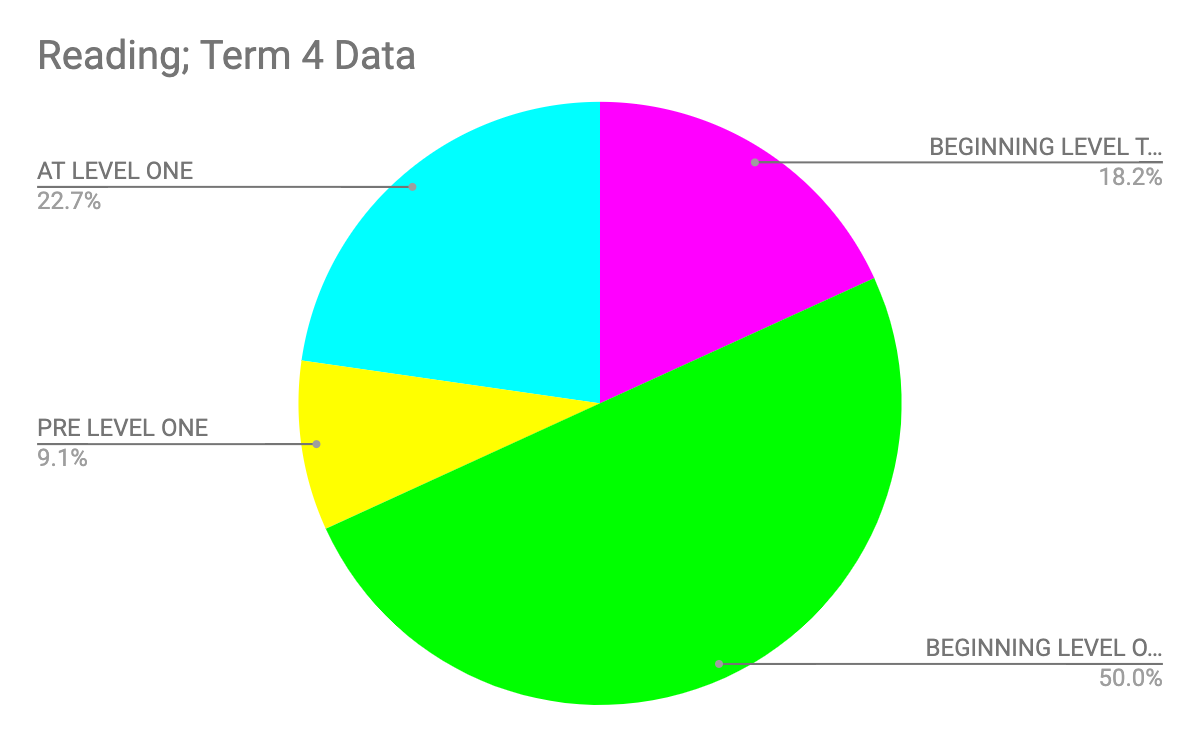
Whole-Class Reading Graph Tracking Students From 0-120 Weeks At School


Target Student Reading Graphs For 0-120 weeks at school

Student 1

Student 2


Student 3


Student 4

Whole-Class Reading OTJ Data 


This data shows that those students that returned to school after lockdown made accelerated progress of expected progress. This surprised me as usually after time off school e.g. summer holidays their reading level drops back. Also, many of my students' families were going through difficult situations due to lockdown/covid and from my own experience, difficult situations at home can influence students learning at school. 
The Pie Graph shows that many of my students are still working below the expected level for their age but some of these students are just one colour wheel level of reaching the expected level. I, therefore, believe that with the continuation of this intervention they would quickly reach where they should be. 

Writing

EAsstle Results Term and Term 4 For Target Students

Results show where my target students sit against National Norm from Week 3 Term 4 EAsttle writing sample. Since this sample was taken my students started to make even greater progress, as shown on the below pie graphs.

Whole-Class Writing OTJ Data 


Their writing shows that they are now able to sequence their ideas. They have the vocabulary to express themselves and their sentence structures are becoming much more complete. Having engaging experiences to write about not only motivated them but they also had so much to share and the language to use that the writing became so much easier. They went from students who would say one or two-word utterances who found it difficult to say a sentence let alone write it....to students producing writing like the piece above. 

Next Step:
My next step is to support my team to implement the intervention across the Junior school. I know implementing change across a team can be challenging, especially gaining buy-in however I hope this data shows that a rich oral language acquisition programme makes a difference to student learning and has the capability to accelerate student progress. 

Saturday, November 28, 2020

What happens when light hits an object?

What happens when light hits an object?

My CoL inquiry has been looking into developing student's oral language using two week, high interest topics hands-on learning tasks. 

This weeks topic has been light.

This has been my lesson sequence:

1) Look at our shadows outside in the play ground. Why do we have a shadow? Does anything else have a shadow. Introduce the words; shadow, opaque, the concept of light coming from a source (the sun) and an object blocking the light's path. 

2) Read in dual language book 'Shadow Sleeps' . Students listen to audio in their first language and take the book home to share with their family.


3. Introduce the concept of reflection e.g. like light bouncing off. Discuss that some objects reflect light. Sit in a circle and students role play light traveling in waves to another person and bouncing off of them. Students take turns to walk across the circle and pretend to bounce off someone. 

4. Give students a torch, mirror, paper plate and magnifying glass.students make a prediction what the light will do when it hits the object. Gift students the words penetrate (meaning the light goes through it), reflect (meaning the light bounces off it), or block (if the object is opaque). Students ten experiment to see what happens. 


5. Explore making rainbows. students say and do as they 

Say And Do Activity

Students say and do as they

  • Fill up a glass of water.
  • Put the glass of water at the edge of a table.
  • Balance it slightly over the edge of the table.
  • Put a piece of paper on the floor next to the table.
  • Shine the light through the water to make a rainbow.

The students then write what they have learnt about light.


Evidence of student learning:

The hand-on activities allowed students to use the new vocabulary in context. Me modelling simple and correct sentence structures using new vocabulary resulted in students themselves copying these structures. For some this was challenging and took effort, however all achieved this. The amount of talking during these sessions was awesome. There were questions being asked and problem solving (critical thinking) happening everywhere you looked.
The student's writing showed the increased fluency due to having 'lots to say' and engagement. Sequencing of ideas and use of new vocabulary. I have also noticed a marked improvement of sentence structures. 


Tuesday, November 3, 2020

Learning About The Water Cycle

When asked the question where does rain come from the only answer my students could give me was that it came from God or "I don't know", with a shrug of their shoulders.

Their amazement during our first activity of simply painting water pictures on the concrete and watching the water evaporate showed that this was a new experience and something they hadn't thought of. Because previous to the experiment we had talked about the sun heating up water and evaporating it, this language transferred easily. 

"Look the water is evaporating...it's going up to the clouds!"

Such simple everyday phenomena brought such amazement and when given the words my students could put these words to an experience that although they had witnessed many times before had never contemplated or understood. 

The second activity we learned about condensation by making a water cycle in a bag. Here the students could see the condensation on the side of the bag as the water heated up and then turned to water vapour and then cooled. We made lots of connections to steam around their house and why the mirror was wet after a shower. We gifted and gifted and gifted more vocabulary!


The third activity was creating a cloud in a jar to show what happens when clouds become heavy with water droplets. This was incredibly exciting and a great way for the students to see what happens. Explaining what words mean is a norm within our classroom therefore if the students didn't know what a word I used meant they would ask. I would take my time to explain the word sometimes using pictures, diagrams as I talked or role play.

The last activity was creating a water filter to understand what happens to water as it runs off the land into our streams and lakes. They were then able to make connections to our drinking water and water conservation that we had touched on earlier on in the year. 

The discussions and writing that resulted from this topic were incredible. All students understood the basics of the water cycle and concepts of evaporation, condensation and precipitation. They loved using the terms and extremely easily explained how their water filters worked.

To collect comparative data I compared an EASTTle writing sample recounting doing one of the experiments to writing about something they did in the weekend. Nearly all the students in my class wrote better quality recounts about doing the experiments than their weekend experiences (bearing in mind it was Halloween). In particular, the organisation of their writing and ideas noticeably improved. I feel this is because they had a lot to say and their ideas flowed naturally in a clear sequence. 

Earlier in the year many of my students struggled to put anything onto paper so this change is huge.

I also believe that these concepts and experiences are now able to be built on throughout their schooling. When my students come across content related to water they will be able to draw on these experiences and have the foundational knowledge that can be built upon. We may not see the benefits of building oral language now but I believe that results will be seen further in their schooling.


Evidence of Student Achievement


In the water cycle, the sun heats the water to do evaporation. It goes up to the cloud to be condensation and if the cloud gets too much water it's going to rain. That's called precipitation. 

By Elijah


The Unit Plan

Sunday, October 25, 2020

Critically Thinking About Text

Here are two activities that I used with my students to get them thinking critically about texts.

The first introduces to the art of debating, taking a point of view as the reader based on your own personal experiences, values and connecting these to the information in the text.

The second uses both information in the story and creativity to change the ending of the fairytale.

My students found both activities extremely motivating and the activities created brilliant opportunities to talk and listen to the viewpoint of others. 


Debating; What Should Jack Do?


1. What is a debate? We talked about the election and how the different parties had to tell the people of New Zealand why they should vote for them. We discussed that in a debate you share your point of view and give a reason. 

2. I then asked if the students thought that Jake should give the cow to the man in exchange for the magic bean or take the cow to the market like his mother asked?

3. I got the students to sit at opposite sides of the mat depending on whether they were 'for' giving the cow to the man, or 'against'. Those students undecided sat in the middle with me.

4. I then told the children it was their job to get me and the other students to move to their side of the mat by giving their argument with justification. I also gave the expectation that they would need to take turns to talk.

5. The debate went backwards and forwards, students listened to each other and even added on to what others were saying and responding to others on the opposing team. 

6. Once all students had their turn at sharing their arguments. I said that I was still undecided as everyone's arguments were fantastic. I then asked them to write at least two different arguments for or against and that I would then choose the winner.

Talk about motivated learners!!!! This was the most animated, vocal and excited I have ever seen them during literacy. The oral language, turn-taking and listening were incredible as was their creative and critical ideas.

I think Jack should listen to his mum because the man must be lying. That bean is fake! It must be fake because he (the man) just wants the cow to eat it.
By Rakeena

I think Jack should give the cow to the man because it (the bean) looks like a plant and it is green (referring to a picture of the beanstalk later in the book)! I think he can sell the bean to customers at the market and the customers can give the money to Jack and he could go home and give the money to mum.
By Virginia in response to Rakeena's argument.


Change The Ending To This Fairytale


Using the sentence starter the students had to write a different ending to the story.

1. I began by reading the big book to the class, stopping at this page. The children had read this text many times over the week so the students were very familiar with the plot. 

2. What if we changed the ending to this story. What if something different happened next? Turn and talk, if you could change the story what would happen?

3. The students then went off to write their endings using the story starter ... 'He crept inside the castle...'.


Jack crept inside the castle and saw a giant sleeping with a goose. The goose laid a gold egg. Inside the egg was a dragon in the egg. Jack went to get the goose and the egg. he went down and down the beanstalk. He went to the market and sold the goose and the egg. Jack got some money. he went to the shop and got some food. he went back home.
By Toko

Saturday, October 24, 2020

Bilingual Approaches Open Linguistic Spaces

Below is an article published in the Education Gazette featuring Room 2's teaching and learning through a bilingual approach in an open linguistic space.

Incorporating the PELP programme into my everyday teaching practice is something I have been exploring as part of my CoL Inquiry into developing an intensive oral language acquisition programme to raise student achievement in literacy. The below whānau and student voice describes the effectiveness of the PELP programme for my learners.

Bilingual Approaches Open Linguistic Spaces


Tamaki Primary School whānau kōrero

Tamariki Q&A

Q: What do you like the most about reading stories in your first language?

A: Because it is my language. I have to speak more so I can be a Tongan person and know people that have passed away. It makes me happy to read books. It is hard to think about the story if you get stuck on it in English. Toko, 7

A: They make me smart. The books have stories and pictures, some are easy and some are hard. Virginia, 7

Q: What do you like the most about speaking your own language at school?

A: You get to teach people different languages and you get to see if anyone else knows your language. I don’t really know much about Niuean and I get to learn about it. Saryah, 6

A: I can teach the teachers how to speak in Tongan. I can speak in Tongan to my friends. Epalahame, 7

Whānau Q&A

Q: Has the Pasifika Early Literacy Project (PELP) helped your child?

A: YES, it has helped my child learn more about our language and culture and it has encouraged our family to speak more of our language at home.

Q: What do you like the most about the dual-language books?

A: The fact that the books have both English and Tongan versions; that way our children can understand what they are reading about and make connections to their culture.

Q: What difference does it make for you (and your child) that they can do some classroom learning in their own language?

A: It makes a huge difference, especially in today’s world. My children are encouraged in the classroom to use their language and it’s amazing for me as a mother, to hear them speak and understand. My child has also taken on the role of sharing and helping other students and teachers to speak our language and he shows great pride in sharing our Lea-fakatonga.

Q: Why do you think this is important?

A: It is significant that my children learn our Lea-fakatonga and to do that in the classroom is amazing. This is a part of their identity as a person and I believe that all our tamariki need to have access to learn their language and about their culture in order for our culture to thrive. This will also teach them how sacred all cultures are no matter the differences and beliefs; we are fortunate to live in Aotearoa as a country that encourages diversity. Jade Fonua


Monday, October 19, 2020

CoL 2021

 There are two areas I would like to focus my work on next year, one being my own inquiry focus and the other being affecting change across my school to better meet our students' needs.


For my own inquiry I’m wanting to continue to focus on literacy across the curriculum, that is my passion and area of expertise. I know that was my focus in my last inquiry, however, there have been surprises that have emerged which I feel need exploring, for example using drama and storytelling, and the effect my solid phonics programme has had on both reading and writing, both Elena - using drama within literacy, and Clarelle’s wonderings about phonics have inspired this thinking. 

I also want to further my understanding of culturally responsive teaching.


Raising literacy achievement especially in reading is a school-wide focus moving into next year and although I have experienced success in my own classroom through change of practice… I have yet to see this change of pedagogy spread across my team (which is something I had hoped for). The Manaiakalani findings through our junior data collection and the research into students starting school highlight the importance of accelerating our students within the first few years at school, building the foundations of early literacy and oral language acquisition. These findings are what challenge me and make me change my teaching to strive to be the best teacher I can be.


How would I like to be supported in 2021?

I would like to be supported by the new leadership within my school, and the experience of leaders across Manaiakalani to affect change of practice across school. I would love to investigate the 'how' of change. I want to learn more about change and how to inspire other teachers to change their pedagogy to better meet students' needs and to continue to help them, themselves, learn, create and share through inquiry. The uptake of teaching as inquiry across our school has been my biggest area of reflection, point of frustration and point of littlest success in my current inquiry (all of which tells me that it is the perfect area of learning for me as a leader). I have been aspiring to inspire teachers to do teaching as inquiry, I have explored using staff meetings, collaborative inquiries and sharing effective practise and PLD with some success but I still feel I have a long way to go. I’m excited about the new management within our school and the possible opportunity to make TAI something that we all do. TIA  is such a powerful change agent. I would love to work with my colleagues more on their inquiries within my school and across Manaiakalani. 


As well, I would like to align my inquiry with the vision of my new principal to support them in the leadership of the school providing data through my inquiry to help drive changes they envision for our school.


Learning Vocabulary Through Creating A Beebot World

Below is an example of the two-week topic that I used with my class. 

As I worked through the unit my focus was on vocabulary and giving multiple opportunities for students to use and reuse through hands-on experiences, and opportunities to talk with peers using that vocabulary. This is now always at the forefront of my mind as I teach. At the beginning of my inquiry, I found this was more of an effort....with practice it has now become automatic and something that has come through on observations of my practice. 

The result is that the students are talking more using the new vocab through multiple opportunities and the vocabulary and concepts attached to that vocabulary is coming through in their writing.


Thursday, August 27, 2020

Monitoring, Recording and Tweaking During Lockdown

What did I plan to do?

My aim going into lockdown was to create culturally responsive, online learning opportunities utilising student's heritage languages. It was also to continue with the intensive oral language programme through high-interest topics outside of their daily worlds, hands-on experiences and exposing students to new vocabulary and using, and reusing this vocabulary.

What did I actually do?

  • Sent home dual language books, a writing book and a pen.
  • Created culturally responsive online learning activities to go with the dual language books.


  • Created videos that took students outside of their daily lockdown worlds, using topics that were high interest. I knew my students loved learning about nature and our native creatures. I used these videos to introduce new vocabulary in context. I hoped they would then use these words in their writing.

  •  
  • Used hands-on activities related to the text we were reading, I was aware from the last lockdown of the limited resources that our students have available at home. So I tried to think of activities that they would have resources for. I was also aware that these activities really worked for some of our students last time.

  • Used google hangouts as an opportunity to get the students writing.
  • Used a facebook post to encourage whānau to help their child to write a story and read a book each day.

How did I monitor my implementation and student progress?


It was harder to monitor the implementation of changes of practice and to know whether it has had an impact on learning. for the main two factors. 
  1. A third of my students came to hangouts and it was difficult to know if the other students were engaging with the learning activities at home. I will have a clearer picture of the home learning that has taken place once we are back to school next week.
  2. I was difficult to see student's work as most have yet to master uploading learning to google drive.
However, here is a description of what I have noticed from my observations.

Different activities and learning resources appeal and are used by different students. What works for one family doesn't necessarily work for another. Having a range of learning opportunities, resources and multimodel options allows all students to access their learning in different ways. Having a writing book, pen and ready to read reading books including dual language books, in a learning pack meant that all families were able to connect to learning at home. The uptake of this we will find out next week when back at school. More of the students that connected were reading and writing each day using these resources than the first lockdown. Was this because I clearly set the expectation this time using my facebook message, and were having writing sessions each day online?

The writing response and quality of writing from the videos I made were fantastic. All students were able to write facts. They were writing with fluency and were able to clearly articulate what they wanted to write and had lots to say. The vocabulary they used was directly from the videos. This showed uptake of the new language.


Having whānau helping was really effective and a great way to build that home/school partnership and whānau involvement in their learning. Some whānau that were not connecting during the last lockdown were joining in every day this time. I want to put out a survey for parents to find out whānau voice and how they experienced online learning. 

Student voice told me the hands-on activities were a hit with some students. It will be interesting to see learning outcomes next week when back at school, as I currently don't have work samples of this.

Below is a sample of an on-line writing session. It shows Cohen sounding out his words and the increased amount of writing these students have been doing, and the engagement of the students.


It was hard to monitor the effect of culturally responsive activities and resources. Return to school next week will hopefully give me a clearer picture of the effectiveness of this change of practice.

Next Steps:

  • Send out a survey for whanau to record their experiences with on-line learning and to gain whānau voice regarding the effectiveness of my change of practice and how it impacted student learning at home.
  • Gather and assess work samples from students returning to school to gain a better understanding of the impact of the implementation of changes of practice during the lockdown.

Thursday, August 20, 2020

Changes To My Teaching Practice During Lockdown

Although I feel I effectively created online lessons that mirrored the intensive oral language programme I was delivering at school, Self-analysis of my teaching practice showed how easy it was to revert back to old teaching habits during difficult and busy times like during the last lockdown. I noticed how I reverting to how I used to teach before I gained a greater understanding of cultural responsiveness and the power of placing immense value on students heritage language and culture.

Looking back at my slides from the previous lockdown I observed

What Worked Well

I was using the learning I had gained from the intensive oral language programme to created online, digital versions of the types of oral language lessons I would have previously taught in class.


What Was Lacking in My Teaching Practice

A flip back to non-culturally responsive teaching was evident in the content I was delivering online. I wasn't harnessing the opportunities for students to learn at home in their first language with whānau. I wasn't providing them with the resources to do this or making the content culturally responsive.

The 2nd Lockdown

Going into Lockdown a second time has given me the opportunity to do things differently. I created learning activities that can be completed in the student's heritage language and that provide opportunities for whānau to share stories and culture. My hope is that having the reading resources in the student's heritage languages allows parents to help them with their learning during this time and allow for students to make connections between the languages they speak at home and English. It is my hypothesis that this will help their language acquisition in both their first language and English.  


Wednesday, April 29, 2020

TAI2020 'Say And Do Activities' In An Online Learning Environment

How does 'saying and doing' look learning online?

My inquiry over the last two years has been to grow student's oral language through an intensive oral language programme implemented across our junior school. 

One of the main changes to our teaching has been 'hands-on tasks' whereby the students talk about what they are doing as they do it, using vocabulary and phrases modelled by the teacher.

Moving into lockdown has made me and my team think about how this could look using a digital platform.

Some other challenges we were facing:


  • Engaging students in their learning, with feedback from parents that they were finding it hard to get their children to focus on their learning at home.  
  • The age of the students as they are too young to follow written instructions, we needed learning activities to be easy for them to understand, independently, without needing help from an adult.
  • Not knowing if students were connecting with the leaning site at home as it has been hard to contact some families.

Evidence of Learning


  • Videos shared with me via email, often through older siblings show engagement and connecting with learning online.
  • Videos show children talking about what they are doing.
  • They have understood the instructions and learning about concepts and contexts outside of their daily worlds.
  • Use of correct sentence structures as they teach others how to do the activity.
Here are some examples of moving our intensive oral language acquisition programme online...


Our Happy Place

Here is the Green Team creating sunbathing rocks for the butterflies in our pollination garden.  There is nothing more beautiful than our ch...