Showing posts with label SPublish. Show all posts
Showing posts with label SPublish. Show all posts
Sunday, October 16, 2022

Tuesday, December 15, 2020
CoL 2020: Evaluation Of The Intervention/ My Changes To Practice
Changes to teaching practice over the last two years have seen significant shifts in my student's oral language acquisition, extremely pleasing progress in reading and surprisingly huge shifts in my student writing data (surprising because I had intended to gain shifts in reading). All within the craziness of teaching and learning with the challenges of Covid-19.
What did I do differently?
- Two-week high-interest topics exposing the students to as much rich vocabulary within contexts that were outside of their day to day worlds or connected to wonderings about everyday phenomena that they didn't have the vocabulary to explain. Before this, we would teach whole school topics for the whole term. By making this change I saw the urgency in exposing students to as many different contexts as possible but still at a deep level. This also meant giving students hands-on engaging activities that they could connect new vocabulary to, and prior experiences and knowledge that they can build onto as they move through their schooling. Example Of Two Week Unit
- Shifted my two-week high-interest topics to a digital platform. For this, I had to be mindful that my young students were mainly learning independently without parent help. I videoed me taking through hands-on activities, using resources they may have at home and explaining, using, reusing and recycling rich vocabulary. Video evidence showed students doing the activities and using the vocabulary at home which was exciting. I kept this going via our class site after lockdown for those students who still had not returned to school and to follow the Manaiakalani Pedagogy of learning being ubiquitous Learning At Home
- Valued the use of students first language within the classroom. This allowed students to make connections to English through their heritage language. I created opportunities for students to learn in their first languages and share their language with others. I utilised the opportunity for families to help their children with their learning at home during lockdown by shifting to more culturally responsive teaching practices. I became aware that I needed to be cognitive about this as it was easy to slip into old habits, especially when faced with a different way of teaching and learning e.g. totally online teaching. A Shift To More Culturally Responsive Teaching
The Effects Of My Changed Practice/Intervention
Reading
Whole-Class Reading Graph Tracking Students From 0-120 Weeks At School

Target Student Reading Graphs For 0-120 weeks at school
 |
| Student 1 |
 |
| Student 2 |
 |
Student 3 Student 4 Whole-Class Reading OTJ Data |

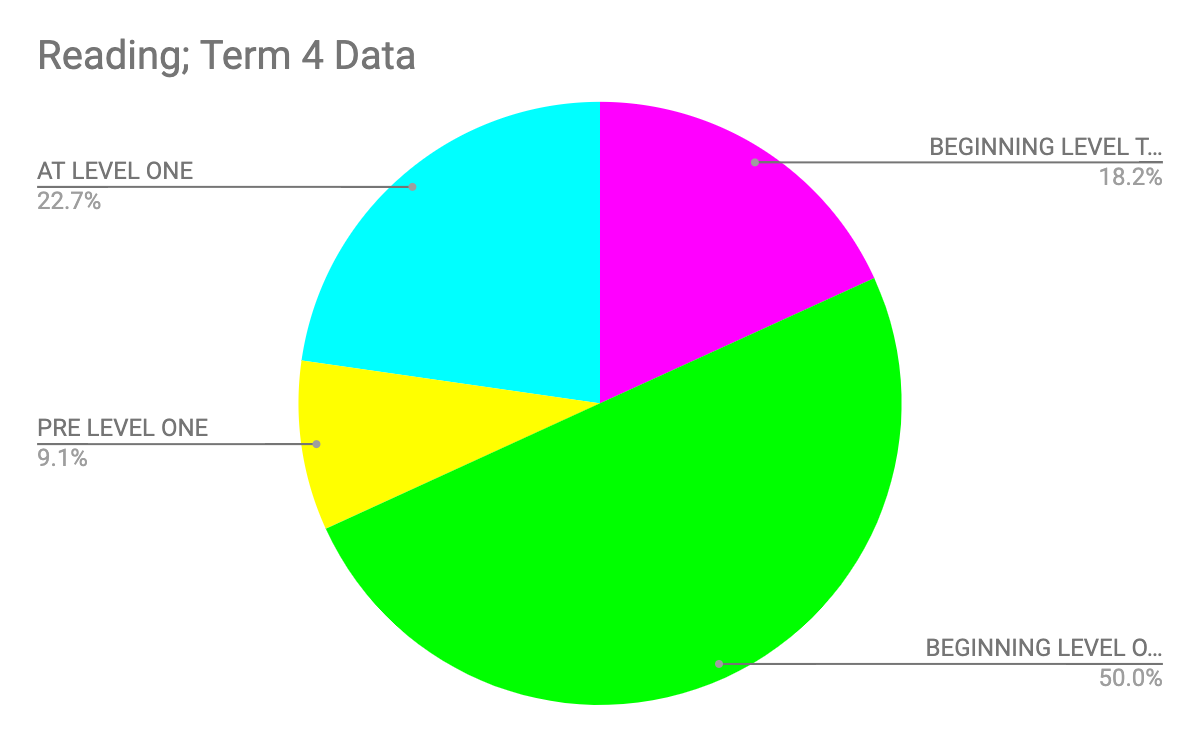
This data shows that those students that returned to school after lockdown made accelerated progress of expected progress. This surprised me as usually after time off school e.g. summer holidays their reading level drops back. Also, many of my students' families were going through difficult situations due to lockdown/covid and from my own experience, difficult situations at home can influence students learning at school.
The Pie Graph shows that many of my students are still working below the expected level for their age but some of these students are just one colour wheel level of reaching the expected level. I, therefore, believe that with the continuation of this intervention they would quickly reach where they should be.
Writing
EAsstle Results Term and Term 4 For Target Students
Results show where my target students sit against National Norm from Week 3 Term 4 EAsttle writing sample. Since this sample was taken my students started to make even greater progress, as shown on the below pie graphs.

Whole-Class Writing OTJ Data


Their writing shows that they are now able to sequence their ideas. They have the vocabulary to express themselves and their sentence structures are becoming much more complete. Having engaging experiences to write about not only motivated them but they also had so much to share and the language to use that the writing became so much easier. They went from students who would say one or two-word utterances who found it difficult to say a sentence let alone write it....to students producing writing like the piece above.
Next Step:
My next step is to support my team to implement the intervention across the Junior school. I know implementing change across a team can be challenging, especially gaining buy-in however I hope this data shows that a rich oral language acquisition programme makes a difference to student learning and has the capability to accelerate student progress.
Saturday, November 28, 2020
What happens when light hits an object?
What happens when light hits an object?
My CoL inquiry has been looking into developing student's oral language using two week, high interest topics hands-on learning tasks.
This weeks topic has been light.
This has been my lesson sequence:
1) Look at our shadows outside in the play ground. Why do we have a shadow? Does anything else have a shadow. Introduce the words; shadow, opaque, the concept of light coming from a source (the sun) and an object blocking the light's path.
2) Read in dual language book 'Shadow Sleeps' . Students listen to audio in their first language and take the book home to share with their family.

3. Introduce the concept of reflection e.g. like light bouncing off. Discuss that some objects reflect light. Sit in a circle and students role play light traveling in waves to another person and bouncing off of them. Students take turns to walk across the circle and pretend to bounce off someone.
4. Give students a torch, mirror, paper plate and magnifying glass.students make a prediction what the light will do when it hits the object. Gift students the words penetrate (meaning the light goes through it), reflect (meaning the light bounces off it), or block (if the object is opaque). Students ten experiment to see what happens.
5. Explore making rainbows. students say and do as they
Say And Do Activity
Students say and do as they
- Fill up a glass of water.
- Put the glass of water at the edge of a table.
- Balance it slightly over the edge of the table.
- Put a piece of paper on the floor next to the table.
- Shine the light through the water to make a rainbow.
The students then write what they have learnt about light.


Evidence of student learning:
The hand-on activities allowed students to use the new vocabulary in context. Me modelling simple and correct sentence structures using new vocabulary resulted in students themselves copying these structures. For some this was challenging and took effort, however all achieved this. The amount of talking during these sessions was awesome. There were questions being asked and problem solving (critical thinking) happening everywhere you looked.
The student's writing showed the increased fluency due to having 'lots to say' and engagement. Sequencing of ideas and use of new vocabulary. I have also noticed a marked improvement of sentence structures.
Wednesday, November 18, 2020
Saturday, October 24, 2020
Bilingual Approaches Open Linguistic Spaces
Below is an article published in the Education Gazette featuring Room 2's teaching and learning through a bilingual approach in an open linguistic space.
Incorporating the PELP programme into my everyday teaching practice is something I have been exploring as part of my CoL Inquiry into developing an intensive oral language acquisition programme to raise student achievement in literacy. The below whānau and student voice describes the effectiveness of the PELP programme for my learners.
Bilingual Approaches Open Linguistic Spaces

Tamaki Primary School whānau kōrero
Tamariki Q&A
Q: What do you like the most about reading stories in your first language?
A: Because it is my language. I have to speak more so I can be a Tongan person and know people that have passed away. It makes me happy to read books. It is hard to think about the story if you get stuck on it in English. Toko, 7
A: They make me smart. The books have stories and pictures, some are easy and some are hard. Virginia, 7
Q: What do you like the most about speaking your own language at school?
A: You get to teach people different languages and you get to see if anyone else knows your language. I don’t really know much about Niuean and I get to learn about it. Saryah, 6
A: I can teach the teachers how to speak in Tongan. I can speak in Tongan to my friends. Epalahame, 7
Whānau Q&A
Q: Has the Pasifika Early Literacy Project (PELP) helped your child?
A: YES, it has helped my child learn more about our language and culture and it has encouraged our family to speak more of our language at home.
Q: What do you like the most about the dual-language books?
A: The fact that the books have both English and Tongan versions; that way our children can understand what they are reading about and make connections to their culture.
Q: What difference does it make for you (and your child) that they can do some classroom learning in their own language?
A: It makes a huge difference, especially in today’s world. My children are encouraged in the classroom to use their language and it’s amazing for me as a mother, to hear them speak and understand. My child has also taken on the role of sharing and helping other students and teachers to speak our language and he shows great pride in sharing our Lea-fakatonga.
Q: Why do you think this is important?
A: It is significant that my children learn our Lea-fakatonga and to do that in the classroom is amazing. This is a part of their identity as a person and I believe that all our tamariki need to have access to learn their language and about their culture in order for our culture to thrive. This will also teach them how sacred all cultures are no matter the differences and beliefs; we are fortunate to live in Aotearoa as a country that encourages diversity. Jade Fonua
Friday, July 17, 2020
How PELP Changed My Practice
What Is Language?
Language is the words or symbols we use to communicate meaning, it is arbitrary, and it can convey information about things that are not present in the current place or time. (Northbrook, 2020)
However, it is far more than a tool to communicate meaning and ideas. It is deeper than that. It is fundamental to what it means to be human. Not only does language learning shape meaning and capability, but it is an integral part of culture and identity. Language and culture are intertwined. With the loss of language, we see the loss of culture and cultural identity. (MOE, 2016)
How taking part in PELP has changed my understanding of literacy acquisition.
PELP has made me aware that building on a child's heritage language or languages helps strengthen the acquisition of English as a second language and I have seen first hand the power of drawing on a child's cultural capital to support literacy learning.
I have known that learning is about making connections, connecting new knowledge and skills to our prior experiences and beliefs, however until recently I hadn't thought about the part language plays in this...if language shapes meaning and capability, then surely making space in the classroom for children to use their heritage language to make connections and build understandings makes sense.
For me, PELP helped me understand the 'why', it showed me the 'how', it supported me in changing my practice to be a better teacher and it opened up possibilities. It quite frankly has totally changed a part of how I teach and my pedagogical beliefs.
I came to Tamaki Primary from a high decile, predominately Pakeha school. Myself having grown up in England for half my life and then teaching in a school that was reflective of my own culture I knew very little of the Pasifika cultures represented within my new school. Although I jumped at the chance to take part in PELP I was completely outside of my comfort zone attending the first workshop. Fear of what you don't know is always scary, which is crazy as we all know that that is usually an indicator opportunity for learning. I can remember clear as day the thought "How can I teach using dual language books when I don't know the language myself?"
From what I know now - I don't need to, I have a have half a class of Tongan speakers who are more than willing to be the experts... I just need to value their language and culture and create space to explore literacy in their language and allow them the opportunities to make connections between Tongan and English.
So what has PELP taught me?
- Opening up opportunities for the students to be the experts, to bring all their knowledge, their culture and language to the table and to be able to connect this to their new learnings.
- Value bilingual and multilingualism and foster it within our classroom. Know that it is easier to acquire a second language when one is strong in their first language.
- Value the cultural capital that students bring to school. Use this to help build literacy acquisition.
- Try speaking in Pasifika languages. Students love it when you attempt to speak their language. This in itself is valuing their identity.
- To use the dual language books as you would any other reader, and utilize the audios online. Think of follow up activities that may help students connect their culture and language with English.
- Create opportunities to use Pasifika languages and cultures across the curriculum e.g. Count in Samoan, use the Cook Island Maori colours in art.
- The importance of listening to families and understanding the students within their family and home context.
What am seeing as a result of my change of practice?
- The students going from not associating the languages they speak at home with the school context and not speaking them within the classroom, to students now using their heritage language across the curriculum.
- Students competing to use their language when we are doing counting or playing games e.g. let's count in Tongan!...no Samoan!,
- Students giving the meaning of Samoan words or telling me what an English word or phrase means in Tongan. They are verbally translating constantly.
- They naturally speak to each other in their own languages in the social context of the classroom.
- They are fiercely proud of their culture.
- Massive confidence and overall happiness of students and a sense of belonging.
- They use the illustrations in the books to discuss the story and make connections to their own experiences.
- Families are realising the importance of building using heratage language and that it can help their children to acquire English as a second language.
- A spark of interest in students that don't speak in their heritage language at home. They have also become aware that they do not know their heritage language from seeing their peers speaking in their language at school.
What are my next steps?
- Increase my knowledge of Pasifika cultures, as this has highlighted how little I know.
- Increase opportunities for families to come in to share their culture with the class.
- Create more ways to be culturally responsive in my teaching practice.
PELP is such an effective programme. I encourage all teachers to run with this opportunity. I have been amazed how easy it actually is to make these changes to your practice and even more amazed at the incredible effects it has on the students.
Push past the fear of not being an expert and make those first few steps... and just see what happens!
Here is a link to my first few reading lessons using the dual language books
Monday, December 16, 2019
CoL: Evaluation Of My Intervention After The First Year
This Evaluation looks at the different parts of our inquiry into creating a culturally responsive intensive oral language programme across the Junior School. It reflects on the three hypotheses developed at the beginning of this inquiry.
Utilising the student's strengths in their first language, working in bilingual and multilingual ways, creating Talanoa, and working in partnership with families will help build students English language and literacy.
Developing oral language through short high-interest topics and real-life experiences, with a focus on intensive oral language acquisition, will create an environment of language in abundance.
A collaborative inquiry across the junior school (Years 1-3) will grow professional capital across the school. The shared inquiry will allow all students across the junior school to benefit from the effectiveness of changed practice and allow teachers to learn from and with each other. It will hopefully also enable an effective changed practice to become sustainable.
Student Voice
Student voice shows that there has been a shift in students feeling comfortable using their first language at school and that the target students see their heritage language as a way to communicate effectively with their peers and family and value themselves as experts when it comes to teaching their teachers their first language. Whereas previously the target students said that they just spoke their first language at home and with friends. They also see changes in my teaching practice such as collaborative learning opportunities, turn taking when talking and using language acquisition activities as ways in which they learn best.Comparison of student voice survey Term 1-4
Pasifika Early Intervention Programme (PELP)
After one Term of the Pasifika Early Literacy Programme (PELP) our Target Students made significant progress in the number of words spoken during the PELP oral language assessment, with the exception of Student 3 who already had a higher English oral language level than the other students. Student 4 didn't speak their heritage language at home which accounts for there low level of heritage language pre and post intervention.This data shows the increase of students confidence speaking their first language at school alongside the increased acquisition of English within that one term.


The graph indicates that on average Junior students increased their oral language after one term of PELP. During this time we changed our teaching practice to incorporate students first language into our teaching programmes, encouraged students to use their first language, used dual language books in class and at home, and connected with families about the importance of students using and learning their first language.
The graph also shows that those students who were also in the Target Group, participating in small group oral language acquisition activities (Dr Jannie Van Hees) went from having a below average oral language level below level to an above average level. These students participated in all Dr Van Hees modelling sessions and classroom sessions lead by the teachers exploring hands on oral language activities, insisting on use of new oral language, picture talk and shared writing sessions using new vocabulary. This shift is far greater than those students not participating in the programme.
It is therefore my conclusion that although we would probably see shift in students oral language through the use of PELP alone we see a far greater shift when we combine this programme with the teaching strategies that make up the Oral Language Intervention Programme designed by Dr Jannie Van Hees.
Combilist Data
The Combilist was used to measure language development factors of all students within my class.Factors important in language development are rated below using the scale Yes/Sometimes/No.
C1-2 indicates willingness to communicate
C3-4 indicates communication with teacher/adults
C5-9 indicates participation in discourse
C10-13 indicates contribution to the discussion or discourse
C14-16 indicates benefits from feedback

Areas that target students made the most gains where:
C2 Keen to express meaningfully and well.
C4 Expresses responses as clearly as he/she can.
C5 Takes the opportunity to speak.
C8 Gives elaborate responses to open-ended questions from the teacher/adult
C9 Reacts and responds spontaneously and on own initiative to teacher.
C12 Thinks before he/she speaks so as to express at a higher cognitive level.
C14 Continues his/her meaning and intentions, and picks up and uses teacher examples and models later.
Areas for continued development are:
C10 Sustains expression of his/her meaning, ideas and intentions.
C15 Meanings and ideas logically developed and expressed.

The rest of the class still struggle with giving elaborate responses and thinking before they speak to express at a higher cognitive level. The gains the target group made in this areas I feel is reflective of my change in practice, pushing students to use more words, new vocabulary, modelling responses and to think before they speak. The graphs show that those students that were 'No' in many categories all shifted to 'Sometimes'. This was not the case for many of the other students within the class that made comparatively little gain in these areas.
These results show that Dr Jannie Van Hees programme does have a substantial impact on oral language acquisition and using Dr Van Hees teaching strategies across the Junior school would benefit all students.
Transference Into Reading
The below graphs show the little progress students made within their first year at school (40 weeks). The graph also shows the progress that was made during the last 20 weeks of which these interventions took place. Although three of the students are working well below the expected level, all have made progress. However, it is hard to say whether this progress would have been made due to changed oral language programme or whether it is due to the normal classroom reading programme.
 | ||
| Student 2 |

 |
| Student 3 |
 |
| Student 4 |
Collaborative Inquiry Into Changed Practice Across The Junior School
The collaborative nature of this inquiry is harder to evaluate however a survey completed by the Junior teachers showed that they all had a clear understanding of the 'why' behind the change in practice and held a shared vision. As a team, we have undertaken a vast amount of PLD this year with DR Jannie Van Hees, the Pasifika Early Literacy Programme and ENGAGE, and shared our new learning with the rest of the school Staff meeting slide deck.
We soon realised that creating changed practice across the Junior school would take longer than anticipated and extended the length of the inquiry from 1 year to 2 years, dedicating the first year to professional development and exploring changes in teaching practice. Teachers were at differing stages of uptake of this new learning due to two teachers being beginning teachers and experiencing all the new learning that comes with teaching your first class. What was important to me was the openness all teachers had to the PLD and that all teachers tried some of the teaching strategies learned.
We began collecting data on all junior students but then realised that it would be more significant to focus on a target group that would participate in all small group intensive oral language activities (Dr Van Hees), PELP and ENGAGE taught by me. Next year as we all implement the new learning we will take data across the Junior School.
During the second year, the aim is for all Junior teachers to fully implement the changes to practice, creating a Junior curriculum that focuses on a culturally responsive intensive oral language acquisition programme.
The Introduction Of ENGAGE
One of the factors that became apparent throughout the inquiry was the impact students low levels of regulation had on students ability to uptake new oral language.
ENGAGE seemed to be the missing piece and when offered the opportunity to participate in the programme starting Term 4 we as a team jumped at the chance.
It is hoped that through the games based programme students will develop self-regulation skills that will help them to uptake new learning.
Data will be used from this programme to support our inquiry moving into its second year.
Sunday, December 15, 2019
Comparison of Student Voice Responses Term 1-Term 4
In order to get a deeper understanding of how students perceived both themselves as learners and the effectiveness of my teaching practice. I conducted a student voice survey in Term 1 and Term 4.
This data shows the areas I still need to work on, evident within the responses to the first three questions. These will help to guide changes to my teaching practice moving forward from here.
This data shows the areas I still need to work on, evident within the responses to the first three questions. These will help to guide changes to my teaching practice moving forward from here.
- developing students self efficacy in writing.
- ensuring all students can gain the help they need from me when they need it, being clearer about using terms like 'see 3 before me' during small group teaching, so that they don't interpret that as being all times of the day.
- finding ways to ensure that all students are listened to while at the same time helping them develop turn taking while speaking.
This data shows strengths in the areas of
- creating a culturally responsive learning environment whereby students feel confident using their first language.
- the use of collaborative learning, students taking turns to speak and students working with buddies.
- The use of resources that encourage literacy in students first language, and the power of having these resources available to go home with the students for home learning with families.
These three areas I see as evidence of the effectiveness of changed practice moving from relatively non-culturally responsive teaching practice to a creating a culturally responsive classroom that embraces the use of student's first languages so they can learn in their first language and make connections between their first language and English. Collaborative learning and students turn-taking when talking are mentioned as ways students learn best, therefore me changing my practice to incorporate these aspects into my teaching has had a positive influence on student learning.
Friday, November 22, 2019
Tuesday, November 5, 2019
ENGAGE
ENGAGE is a programme designed to teach self-regulation skills through games. After mastering the game of Simon Says we extended it by playing the game in Tongan. Students soon realised that watching and thinking was an important part of listening so they could understand the instruction. 'Simon' pointed to the parts of his body as he said the instruction in his first language so non-Tongan speakers could understand. This extension raised the cognitive level, the challenge and engagement.
ENGAGE has been the missing piece in our Inquiry into creating an intensive oral language programme for our Juniors.
We were struggling implementing changed practice due to many students low levels of self-regulation. Unable to slow their bodies and minds down and engage with what was being said by the teacher and peers it made uptake of new oral language difficult.
ENGAGE uses common language taught through games e.g. when playing 'Silence' where children complete a challenge in 'Silence' the teacher says "It is important that you listen carefully to the instructions so you know what to do." This phrase is then repeated by the teacher in other areas of the curriculum or parts of the day when students are needing to use the same skills in a different context.
Initially students find the games challenging, this was something we had not anticipated as they seem like simple games. However sticking with the same game over a few weeks the children do gain the skills needed and the game can then be extended to up the challenge and sharpen their self-regulation skills.
Being strategic about implementing the skills and common language across the curriculum has already shown itself to be working. It is giving student cues to use the needed skills and has helped them to get themselves ready for learning.
Next year we will be fully implementing this programme across the Junior school from day one of the Term and sharing the programme with parents at the start of the year.
ENGAGE has been the missing piece in our Inquiry into creating an intensive oral language programme for our Juniors.
We were struggling implementing changed practice due to many students low levels of self-regulation. Unable to slow their bodies and minds down and engage with what was being said by the teacher and peers it made uptake of new oral language difficult.
ENGAGE uses common language taught through games e.g. when playing 'Silence' where children complete a challenge in 'Silence' the teacher says "It is important that you listen carefully to the instructions so you know what to do." This phrase is then repeated by the teacher in other areas of the curriculum or parts of the day when students are needing to use the same skills in a different context.
Initially students find the games challenging, this was something we had not anticipated as they seem like simple games. However sticking with the same game over a few weeks the children do gain the skills needed and the game can then be extended to up the challenge and sharpen their self-regulation skills.
Being strategic about implementing the skills and common language across the curriculum has already shown itself to be working. It is giving student cues to use the needed skills and has helped them to get themselves ready for learning.
Next year we will be fully implementing this programme across the Junior school from day one of the Term and sharing the programme with parents at the start of the year.
Saturday, October 19, 2019
Subscribe to:
Posts (Atom)
Our Happy Place
Here is the Green Team creating sunbathing rocks for the butterflies in our pollination garden. There is nothing more beautiful than our ch...
