Sunday, September 6, 2020

KPMG Hui Term 3

Finally, we meet again face to face. Today's MIT hui at KPMG was the only time since February that we have actually been able to get together. It goes to show how February's hui cemented the relationships between the team that we would carry throughout the year. It was fantastic having the setting of KPMG, away from school (and home), to allow for fresh thinking to take place. 

Today's hui gave an opportunity for us to share our almost finished digital tools and gain feedback from our peers. 

As is always the way, feedback points out all those things you don't see yourself, the things you are blinded to when you are looking at it from one perspective. Even the simplest things are often something that doesn't even cross your mind until pointed out to you.

This is the website so far:

Draft ENGAGE Site

Feedback From The MIT Team

The feedback I received focused on writing the content of the site so that whānau can understand by avoiding teacher talk and to hook whānau in to explore the site by showing them how it meets a need.

Next steps to think about:

  • Think about 'what is the need that this website meets?' and pitch meeting this on the home page to draw whānau in. This is the selling point. Will whānau be hooked into looking further into the site? The answer to this at the moment is no. Therefore I need to think of it from a marketing point of view. Could the header be a staged photo of parents with speech bubbles saying something like "It doesn't have to be like this!" "Have you noticed your child..." "If only my child could.."


  • Write a description under How To Play videos so that whānau can get a summary of how to play the game without having to watch the videos.


  • Change the header Whānau Voice to a parent-friendly header, what I have is teacher talk, not parent talk. Change it to "What is our whānau saying?" 

  • Include comments/ testimonials from whānau e.g. quotes from whānau saying how the children have benefitted from playing the games.

  • Give to whānau to trial and to gain feedback 

  • Rewrite parent questionnaire to everyday language or translate into Te Reo Māori, Samoan or Tongan e.g. which of these skills are important to learn?


Thursday, August 27, 2020

Monitoring, Recording and Tweaking During Lockdown

What did I plan to do?

My aim going into lockdown was to create culturally responsive, online learning opportunities utilising student's heritage languages. It was also to continue with the intensive oral language programme through high-interest topics outside of their daily worlds, hands-on experiences and exposing students to new vocabulary and using, and reusing this vocabulary.

What did I actually do?

  • Sent home dual language books, a writing book and a pen.
  • Created culturally responsive online learning activities to go with the dual language books.


  • Created videos that took students outside of their daily lockdown worlds, using topics that were high interest. I knew my students loved learning about nature and our native creatures. I used these videos to introduce new vocabulary in context. I hoped they would then use these words in their writing.

  •  
  • Used hands-on activities related to the text we were reading, I was aware from the last lockdown of the limited resources that our students have available at home. So I tried to think of activities that they would have resources for. I was also aware that these activities really worked for some of our students last time.

  • Used google hangouts as an opportunity to get the students writing.
  • Used a facebook post to encourage whānau to help their child to write a story and read a book each day.

How did I monitor my implementation and student progress?


It was harder to monitor the implementation of changes of practice and to know whether it has had an impact on learning. for the main two factors. 
  1. A third of my students came to hangouts and it was difficult to know if the other students were engaging with the learning activities at home. I will have a clearer picture of the home learning that has taken place once we are back to school next week.
  2. I was difficult to see student's work as most have yet to master uploading learning to google drive.
However, here is a description of what I have noticed from my observations.

Different activities and learning resources appeal and are used by different students. What works for one family doesn't necessarily work for another. Having a range of learning opportunities, resources and multimodel options allows all students to access their learning in different ways. Having a writing book, pen and ready to read reading books including dual language books, in a learning pack meant that all families were able to connect to learning at home. The uptake of this we will find out next week when back at school. More of the students that connected were reading and writing each day using these resources than the first lockdown. Was this because I clearly set the expectation this time using my facebook message, and were having writing sessions each day online?

The writing response and quality of writing from the videos I made were fantastic. All students were able to write facts. They were writing with fluency and were able to clearly articulate what they wanted to write and had lots to say. The vocabulary they used was directly from the videos. This showed uptake of the new language.


Having whānau helping was really effective and a great way to build that home/school partnership and whānau involvement in their learning. Some whānau that were not connecting during the last lockdown were joining in every day this time. I want to put out a survey for parents to find out whānau voice and how they experienced online learning. 

Student voice told me the hands-on activities were a hit with some students. It will be interesting to see learning outcomes next week when back at school, as I currently don't have work samples of this.

Below is a sample of an on-line writing session. It shows Cohen sounding out his words and the increased amount of writing these students have been doing, and the engagement of the students.


It was hard to monitor the effect of culturally responsive activities and resources. Return to school next week will hopefully give me a clearer picture of the effectiveness of this change of practice.

Next Steps:

  • Send out a survey for whanau to record their experiences with on-line learning and to gain whānau voice regarding the effectiveness of my change of practice and how it impacted student learning at home.
  • Gather and assess work samples from students returning to school to gain a better understanding of the impact of the implementation of changes of practice during the lockdown.

Thursday, August 20, 2020

Changes To My Teaching Practice During Lockdown

Although I feel I effectively created online lessons that mirrored the intensive oral language programme I was delivering at school, Self-analysis of my teaching practice showed how easy it was to revert back to old teaching habits during difficult and busy times like during the last lockdown. I noticed how I reverting to how I used to teach before I gained a greater understanding of cultural responsiveness and the power of placing immense value on students heritage language and culture.

Looking back at my slides from the previous lockdown I observed

What Worked Well

I was using the learning I had gained from the intensive oral language programme to created online, digital versions of the types of oral language lessons I would have previously taught in class.


What Was Lacking in My Teaching Practice

A flip back to non-culturally responsive teaching was evident in the content I was delivering online. I wasn't harnessing the opportunities for students to learn at home in their first language with whānau. I wasn't providing them with the resources to do this or making the content culturally responsive.

The 2nd Lockdown

Going into Lockdown a second time has given me the opportunity to do things differently. I created learning activities that can be completed in the student's heritage language and that provide opportunities for whānau to share stories and culture. My hope is that having the reading resources in the student's heritage languages allows parents to help them with their learning during this time and allow for students to make connections between the languages they speak at home and English. It is my hypothesis that this will help their language acquisition in both their first language and English.  


Monday, August 10, 2020

Manaiakalani Create Staff Meeting Workshop

Lovely to see my Manaiakalani Junior Colleagues at the workshop I presented today. Great to hear your creative ways of using Beebots in the classroom. How lucky are we to have such a wonderful bunch of passionate teachers to share ideas with!

Here is the slide deck to today's presentation.


Thursday, July 30, 2020

Inquiring Into Specific Aspects Of My Current Teaching Practice

Main Learning About My Teaching and My Next Steps

To be reflective is uncomfortable. I'm a firm believer in those aspects of your teaching that you become defensive about are probably the aspects that most need changing.

I have observed three aspects relating to my teaching where that uncomfortable feeling rose from my gut. Indicating an area that I need to reflect on. Below is a description of those moments and what it has meant to me in regards to areas I can make changes to my practices.

Situation 1

During an observation of behaviours of students within my class, my DP observed two students rushing through their writing. We had a great reflective discussion regarding the possible expectations I have of these students. 

Some questions I reflected on:

Do I have lower expectations of these boys who find it difficult to stay focused and complete tasks to the same level as other students? Thinking back to lockdown these were the boys who refused to do online learning when their parents asked them too. What is causing this divergence? If I up my expectation of these students will they persevere more with their learning?  One of these boys is a fidgeter and struggles writing his letters in sequence. Does observing these tendencies lower my expectation of writing output? What would happen if I lifted the bar? How can I motivate them to write more, for longer periods? How can I use self-directed learning and student agency to accelerate progress with these students?

Situation 2

Every now and then we come across a difficult situation that takes us by surprise and makes us evaluate how we see the world. My second reflection on my teaching practice is not actually directly related to my teaching. It was a cultural misunderstanding by me that made me reflect on the value of Whanaungatanga and my understanding of what this means. 

My instant reaction to a conflicting situation that arose was to stand my ground in what I believed in, but I was wrong to do this. I needed instead to look at how others see the situation to truly learn from the experience. The situation that arose (without going into details) could easily put down to miscommunication, however, I believe the real problem was my own lack of knowledge of Māori culture, values, and the Tikanga of Whanaungatanga. I am on a personal journey to grow my understanding of Te Ao Māori and this highlighted important new learning for me.

The situation made me reflect on how I have been brought up. I have grown up in an English family who are insular in our ways. We are not part of a large community, we don't go to church or have large family gatherings, I didn't play team sports and although I will do anything to help I often need to be told what to do. Whanaungatanga is something I am having to learn.

How much do my Pakeha beliefs and values come into my daily teaching practice that I am not even aware of? Of course, they are going to, but I truly believe I need to acknowledge my culture and put it to one-side and embrace Māori and Pasifika culture, to teach Māori as Māori and Pasifika as Pasifika in culturally responsive ways. I'm sure I will not be successful all the time and I will make cultural mistakes (as indicated above) but if we are putting students in the centre of teaching and learning, then expecting them to assimilate to Pakeha culture is not the way, it is putting us in the centre instead.

Situation 3

The third learning about my teaching is how easy it is to revert back to the comfortable, the well-established ways of teaching. Looking at my learning site during lockdown is an example of this...

There were great things I was doing on my site to engage learners, make learning accessible for those students that were working independently without adult help and continuing with ways to accelerate language acquisition through our work with Dr Jannie Van Hees. However, the one thing that slipped away was culturally responsive teaching. This tells me that that I have a long way still to go until culturally responsive teaching practice is a natural way of teaching and a part of all that I do. When the hugeness of lockdown happened and we had to change how we taught and students learned in many ways. That is the one thing that dropped off. This tells me that there is so much more work, learning, changes to my everyday practice that I need to make to ensure culturally responsive teaching is at the forefront of my practice.

Summary
  • High expectations for all students. Student agency and self-directed learning to engage, motivate and encourage perseverance amongst the boys in my class.
  • Acknowledgement of my own culture and putting my culture perspectives aside to truly learn about and experience Te Ao Māori and increase my cultural responsiveness.
  • Keep the changes I am making to my practice in terms of PELP and culturally responsive practice at the forefront, even when times are challenging and you feel yourself reverting back to past ways of teaching.

Friday, July 17, 2020

How PELP Changed My Practice

What Is Language?


Language is the words or symbols we use to communicate meaning, it is arbitrary, and it can convey information about things that are not present in the current place or time. (Northbrook, 2020)

However, it is far more than a tool to communicate meaning and ideas. It is deeper than that. It is fundamental to what it means to be human. Not only does language learning shape meaning and capability, but it is an integral part of culture and identity. Language and culture are intertwined. With the loss of language, we see the loss of culture and cultural identity. (MOE, 2016)

How taking part in PELP has changed my understanding of literacy acquisition.


PELP has made me aware that building on a child's heritage language or languages helps strengthen the acquisition of English as a second language and I have seen first hand the power of drawing on a child's cultural capital to support literacy learning.

I have known that learning is about making connections, connecting new knowledge and skills to our prior experiences and beliefs, however until recently I hadn't thought about the part language plays in this...if language shapes meaning and capability, then surely making space in the classroom for children to use their heritage language to make connections and build understandings makes sense.  

For me, PELP helped me understand the 'why', it showed me the 'how', it supported me in changing my practice to be a better teacher and it opened up possibilities. It quite frankly has totally changed a part of how I teach and my pedagogical beliefs. 

I came to Tamaki Primary from a high decile, predominately Pakeha school. Myself having grown up in England for half my life and then teaching in a school that was reflective of my own culture I knew very little of the Pasifika cultures represented within my new school. Although I jumped at the chance to take part in PELP I was completely outside of my comfort zone attending the first workshop. Fear of what you don't know is always scary, which is crazy as we all know that that is usually an indicator opportunity for learning. I can remember clear as day the thought "How can I teach using dual language books when I don't know the language myself?" 

From what I know now - I don't need to, I have a have half a class of Tongan speakers who are more than willing to be the experts... I just need to value their language and culture and create space to explore literacy in their language and allow them the opportunities to make connections between Tongan and English. 

So what has PELP taught me?


  • Opening up opportunities for the students to be the experts, to bring all their knowledge, their culture and language to the table and to be able to connect this to their new learnings.
  • Value bilingual and multilingualism and foster it within our classroom. Know that it is easier to acquire a second language when one is strong in their first language.
  • Value the cultural capital that students bring to school. Use this to help build literacy acquisition.
  • Try speaking in Pasifika languages. Students love it when you attempt to speak their language. This in itself is valuing their identity.
  • To use the dual language books as you would any other reader, and utilize the audios online. Think of follow up activities that may help students connect their culture and language with English.
  • Create opportunities to use Pasifika languages and cultures across the curriculum e.g. Count in Samoan, use the Cook Island Maori colours in art.
  • The importance of listening to families and understanding the students within their family and home context. 

What am seeing as a result of my change of practice?


  • The students going from not associating the languages they speak at home with the school context and not speaking them within the classroom, to students now using their heritage language across the curriculum.
  • Students competing to use their language when we are doing counting or playing games e.g. let's count in Tongan!...no Samoan!,
  • Students giving the meaning of Samoan words or telling me what an English word or phrase means in Tongan. They are verbally translating constantly.
  • They naturally speak to each other in their own languages in the social context of the classroom.
  • They are fiercely proud of their culture. 
  • Massive confidence and overall happiness of students and a sense of belonging.
  • They use the illustrations in the books to discuss the story and make connections to their own experiences. 
  • Families are realising the importance of building using heratage language and that it can help their children to acquire English as a second language. 
  • A spark of interest in students that don't speak in their heritage language at home. They have also become aware that they do not know their heritage language from seeing their peers speaking in their language at school.

What are my next steps?


  • Increase my knowledge of Pasifika cultures, as this has highlighted how little I know.
  • Increase opportunities for families to come in to share their culture with the class. 
  • Create more ways to be culturally responsive in my teaching practice.

PELP is such an effective programme. I encourage all teachers to run with this opportunity. I have been amazed how easy it actually is to make these changes to your practice and even more amazed at the incredible effects it has on the students. 

Push past the fear of not being an expert and make those first few steps... and just see what happens!


Here is a link to my first few reading lessons using the dual language books 


Friday, July 3, 2020

Manaiakalani Digital Student Teacher Practicum

I have been lucky enough to be a part of the Manaiakalai Digital Teacher Practicum 2020.  Gabriel Francis, Eugene Kim, Luke Xia and Rachel Ernst, Graduate Diploma of Education Students from The University of Auckland were given the task of creating an online learning site to meet the needs of our students.

I have thoroughly enjoyed the process of being an online tutor teacher, especially after just going through the lockdown journey. Sharing some of my own learning with others about to embark on their teaching career and reflecting on what has been effective for my students learning online at home has strengthened my beliefs about effective teaching online.

Here is our journey over the last few weeks:

Designing The Brief

First I set about creating a brief for my student teachers. This process in itself was a great opportunity for me to reflect on what has worked for me and my students over the COVID period learning online at home. Summarising the needs of my students gave me the opportunity to really think about where they are right now with their learning and what I would like them to achieve next.
I have had my students for a year and a half and know them and their needs extremely well. However, articulating these needs to my students in the brief was so important as knowing your students allows you to create effective learning tasks that are just right for the individual learner. The students hadn't met the learners and I really had to think "What do these teachers need to know about my children in order to create a successful learning opportunity?"

They certainly didn't have an easy task. Our student's needs are complex...


Delivering The Brief

It was really exciting meeting Gabriel Francis, Eugene Kim, Luke Xia and Rachel Ernst over Google Hangouts. Their enthusiasm and passion for what they are doing was instantly evident. As I started going through my brief I was sure I was overloading them with info.
I was on a release that day so took my laptop into my classroom and airplayed the hangout so my class could introduce themselves. This was brilliant as the class remembered this when it came to introducing them to the learning site. I left the hangout thinking what a huge task this was for our student teachers and at the same time super excited to see what the results would be.
I also invited them to school to see for themselves the effectiveness of the site as I delivered it to my students two weeks later.

Receiving The Site and Giving Initial Feedback


Wow! I was completely blown away. These guys had totally nailed the brief. Every element was covered from making hands-on learning activity videos to creating tasks whereby students could work together in groups. They understood that my students working at home may have limited resources and valued my oral language focus across the curriculum. They even made a video using some Samoan. The learning tasks are rich activities that build on students prior knowledge and the whole site scaffolds the students learning and allows for multiple entry and exit points. They also hit the nail on the head in terms of pitching the site at the correct level. This is hard to do when you don't know the learners and have limited classroom experience.

Sharing The Learning Site With My Students

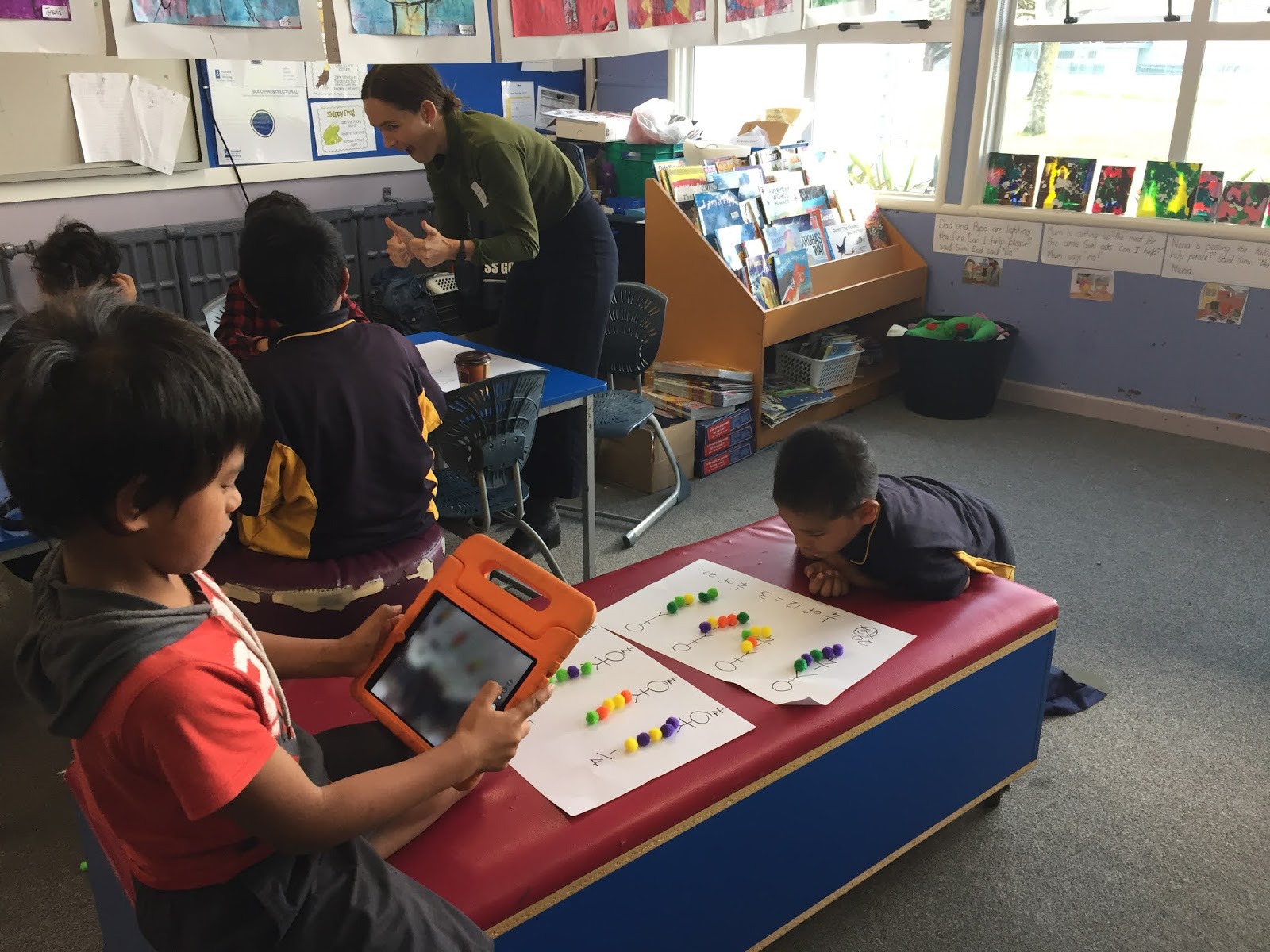
Luke, Gabby and Eugene came to school to see the learning in action


Summary


Gabriel Francis, Eugene Kim, Luke Xia and Rachel Ernst met the brief to an exceptional standard. It is an engaging and fun site that allows our students to explore fractions through hands-on language experience activities. The videos were amazing. They gave clear and simple instructions including the use of new vocabulary reused and recycled throughout the site. The children were then able to independently do the activities and revisit the learning over and over again if needed. They thought about the brief and showed a clear understanding of my students and their learning needs and how to create rich ‘hands-on’ learning activities online using video. 
They took into account the limited resources that many of my students have at home (including making sure they can access learning without having one on one support from parents), their culture and language, the fact that our students learn best working together.
I loved how they acknowledge our focus on accelerating oral language acquisition by explicitly teaching new vocabulary and concepts. 
The games are a fantastic resource for teachers to use and the lesson plan is a great extra.
The children loved the site. They were extremely engaged and it was pitched at exactly the right level. The activities challenged them and scaffolded the learning perfectly.
There is so much content on the site that we will be exploring it for weeks after the holidays. I have also left it on our class site so they can continue to access it over the holidays if they wish to. 
It was wonderful to have Luke, Gabby, and Eugine join us to introduce the site to my class. They were able to see how fantastically it worked in reality. They instantly built a rapport with the students and the children thought they were wonderful.

We have been very lucky to be given this fantastic teaching and learning resource and I have thoroughly enjoyed the process of working with Gabby, Luke, Eugene and Rachel. Your site really does fit the brief perfectly!

I wish you all the best with the rest of your year and the beginnings of an exciting teaching career ahead. 


Friday, June 19, 2020

TIA20 Academic Reading; Krashen


S. Krashen


Facilitating language comprehension; what we do as teachers naturally and what we should actually focus on.


Slowed down speech, clearer articulation, use of more high-frequency words, syntactic simplification, shorter sentences and the use of fewer idioms may appear to promote language comprehension however this limits students to minimal language input. Secondly, we actually tend to make these changes naturally when speaking to a second language speaker, therefore, this is not what we as teachers need to focus on.

Instead, it is important to focus on comprehension and communication and if we do this then the syntactic requirements will follow suit. (Krashen, 1982)

"Believe that your child can understand more than he or she can say, and seek, above all, to
communicate... "If you concentrate on communicating, everything else will follow." (Brown,
1977, p. 26. in Krashen, 1982)

Krashen highlights these strategies as effective methods of teaching language acquisition.

  • Check students comprehension by monitoring their verbal and non-verbal responses.
  • Use pictures and objects to encourage language acquisition. This helps students to understand concepts outside of what they know.
  • Take advantage of what student's know about in the world however, be aware that if the context is too familiar they may have little or no interset and uptake will be minimal. Utilize their curiosity of contexts outside their known worlds whilst helping them make connections to what they already understand.
  • Share the process of language acquisition with the students so that they can continue to progress and be aware of their progress independently.

These points affirm the work of Dr Jannie Van Hees and the intensive oral language acquisition work I have currently been doing. I want to be much more open with my students about the process of language acquisition. This is something I remember Jannie discussing with students on one of her modelling sessions for us teachers. This will help them to be metacognitive and add value to what we are doing. It will also help them to continue with their language acquisition when they are not in the class situation.

Krashen, S. (1982). Principles and practice in second language acquisition.

TAI20 Professional Reading; The Oral Language Book by Sheena Camaron and Louise Dempsey

The Oral Language Book; Sheena Cameron and Louise Dempsey


Traits of Effective Teachers of Oral Language


  • Explicitly teach speaking skills
  • Engage in dialogue not monologue
  • Model, scaffold support and guide speaking and listening learning in the classroom
  • Create a safe respectful talking environment
  • Explicitly teach listening skills
  • Explicitly teach vocabulary

What am I doing already? What can I do differently?


What am I already doing?
What can I do differently? 
Ideas are taken from Sheena Cameron and Louise Dempsey's The Oral Language Book
Explicitly teach speaking skills
Encourage students to speak in sentences, not one-word answers.
Modelled and shared, guided and independent speaking and listening approach gradually releasing responsibility (Pearson and Gallagher, 1983)
Engage in dialogue not monologue
Say and do activities
Think-pair-share instead of hands up…. I still need to work on ‘no hands up’

Think, pair, walk and talk
Model, scaffold support and guide speaking and listening learning in the classroom
Provide devices and opportunities for students to record and listen back to themselves speaking.

Model correct sentence structures, encourage students to use correct sentence structures. 
Scaffold speaking and listening using talking strips 

Doughnut circles
Create a safe respectful talking environment
Really listen to students and encourage students to really listen to each other.

Value and encourage the use of heritage language in the classroom.

Allow for think time and allow students to work with a partner or in small groups. 

Explicitly teach listening skills
Engage Games with focus on listening carefully
Barrier Games
Construct charts describing what good listeners do
Explicitly teach vocabulary
Drama and role play
Retelling
Word pictures


Cameron, C & Dempsey, L (2016). The Oral Language Book, Auckland: S&L Publishing Ltd.


Saturday, June 13, 2020

TAI20 Revisiting my Hypothesis


This graph shows me how my students are tracking in reading over time using Term 2 running record reading data. I can identify students whose progress has plateaued as well as those students that are making slower than expected progress. 

As I am able to identify the students, it is interesting to note that results plateaued for many of the students that didn't connect during the lockdown. Whereas, those students that did connect have all continued to make progress (this is with exception to one student). This data was collected 3 weeks after returning to school.

This is my second year teaching this group of students, and my second year of inquiring into my practice in order to raise these the achievement outcomes of these students. 

Last year I identified that most students didn't begin to make progress through the reading levels until around their first year at school. It is my hunch that factors contributing to this could be the extremely low levels of the oral language they have at school entry, the social, economic and health factors influencing their readiness to learn and the acquisition of English as a second language within their first year at school. These were the factors influencing my hypothesis during the first year of this inquiry and informed my changes of practice up until this point.

My hypothesis has been...

Utilising the student's strengths in their first language, working in bilingual and multilingual ways, creating Talanoa, and working in partnership with families will help build students English language and literacy.

Developing oral language through short high-interest topics and real-life experiences, with a focus on intensive oral language acquisition, will create an environment of language in abundance.


A collaborative inquiry across the junior school (Years 1-3) will grow professional capital across the school. The shared inquiry will allow all students across the junior school to benefit from the effectiveness of changed practice and allow teachers to learn from and with each other. It will hopefully also enable an effective changed practice to become sustainable.


ENGAGE games were introduced towards the end of the first year in response to students inability to self-regulate and the effect this was having on their ability to listen and engage in learning.


I feel it is important to keep the same hypothesis however I have seen significant shifts in many of my students, however, I now want to shift my focus away from those students that this has worked for (as I hope that me continuing with methods that have worked will keep on working for these students) towards those students that are not making the expected progress. What can I do differently so that those achieving keep on achieving and those that aren't making the progress do too!For me, certain aspects of this hypothesis have been explored more than others...The standout area that last year I didn't explore was 'working in partnership with families will help build students English language and literacy.' Lockdown has made me realise that even though I thought up until that point I had developed strong home-school partnerships, I really hadn't. How can I use the strong relationships that I formed over lockdown to make a difference to the outcomes of those students that are not making the expected progress?
If I work in partnership with families then student learning will flow across home-school contexts and the student, whānau and school will have a greater common understanding of learning needs and the best ways to meet those learning needs.
Although I will be collecting and analysing data across my class. I will form a new focus group consisting of students that are not making the same progress as others within my class.


Our Happy Place

Here is the Green Team creating sunbathing rocks for the butterflies in our pollination garden.  There is nothing more beautiful than our ch...